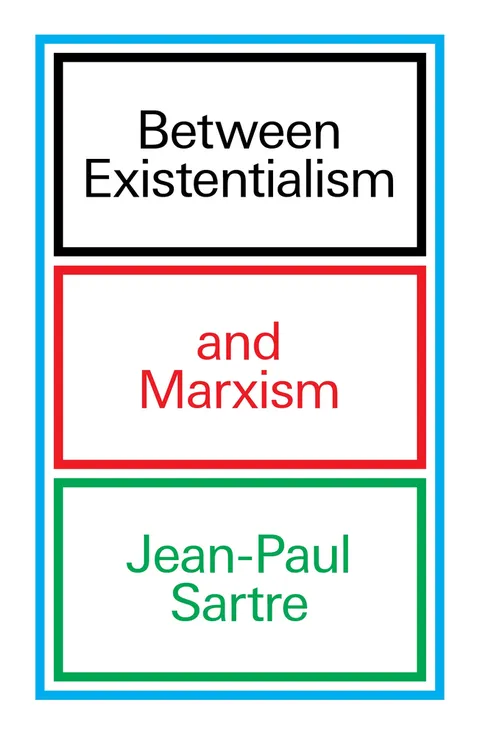
Between Existentialism and Marxism
Report an issue
Tell us what's wrong and we'll take a look.
Thanks – we got it. We'll review and follow up if needed.
A long and brilliant autobiographical interview, given to New Left Review in 1969, constitutes the best single overview of Sartre's whole intellectual evolution. Three analytic texts on the US war in Vietnam, the Soviet invasion of Czechoslovakia, and the lessons of the May Revolt in France, define his political positions as a revolutionary socialist. Questions of philosophy and aesthetics are explored in essays on Kierkegaard, Mallarme and Tintoretto.
Another section of the collection explores Sartre's critical attitude to orthodox psychoanalysis as a therapy, and is accompanied by rejoinders from colleagues on his journal Les Temps Modernes. The volume concludes with a prolonged reflection on the nature and role of intellectuals and writers in advanced capitalism, and their relationship to the struggles of the exploited and oppressed classes. Between Existentialism and Marxism is an impressive demonstration of the breadth and vitality of Sartre's thought, and its capacity to respond to political and cultural changes in the contemporary world.
Jean-Paul Sartre
Jean-Paul Sartre was a philosopher, novelist, public intellectual, biographer, playwright and founder of the journal Les Temps modernes. Born in Paris in 1905, Sartre was awarded the Nobel Prize for Literature in 1964 - and turned it down. His books include Nausea, Intimacy, The Flies, No Exit, The Freud Scenario, War Diaries, Critique of Dialectical Reason, and the monumental treatise Being and Nothingness. He died in 1980.
More by Jean-Paul Sartre








Why Readwise Books?
Readwise Books is an ebook & audiobook platform that automatically logs how much you and your friends read, making it fun and easy to read more. Learn more →