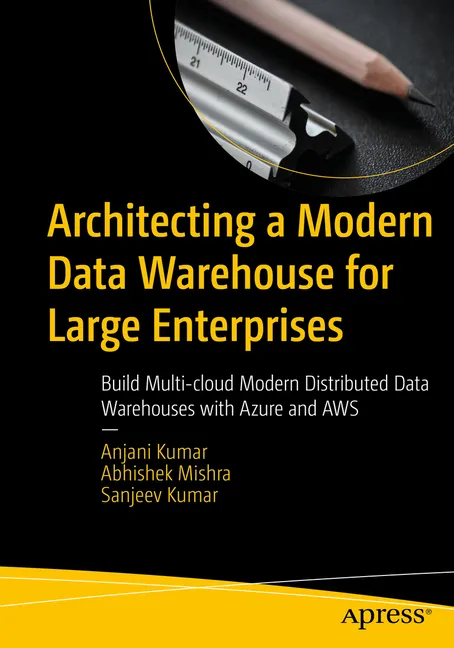
Architecting a Modern Data Warehouse for Large Enterprises
Build Multi-Cloud Modern Distributed Data Warehouses with Azure and AWS
Report an issue
Tell us what's wrong and we'll take a look.
Thanks – we got it. We'll review and follow up if needed.
Design and architect new generation cloud-based data warehouses using Azure and AWS. This book provides an in-depth understanding of how to build modern cloud-native data warehouses, as well as their history and evolution.
The book starts by covering foundational data warehouse concepts, and introduces modern features such as distributed processing, big data storage, data streaming, and processing data on the cloud. You will gain an understanding of the synergy, relevance, and usage data warehousing standard practices in the modern world of distributed data processing. The authors walk you through the essential concepts of Data Mesh, Data Lake, Lakehouse, and Delta Lake. And they demonstrate the services and offerings available on Azure and AWS that deal with data orchestration, data democratization, data governance, data security, and business intelligence.After completing this book, you will be ready to design and architect enterprise-grade, cloud-based modern data warehouses using industry best practices and guidelines.
What You Will Learn
- Understand the core concepts underlying modern data warehouses
- Design and build cloud-native data warehouses Gain a practical approach to architecting and building data warehouses on Azure and AWS
- Implement modern data warehousing components such as Data Mesh, Data Lake, Delta Lake, and Lakehouse
- Process data through pandas and evaluate your model's performance using metrics such as F1-score, precision, and recall
- Apply deep learning to supervised, semi-supervised, and unsupervised anomaly detection tasks for tabular datasets and time series applications
Who This Book Is For
Experienced developers, cloud architects, and technology enthusiasts looking to build cloud-based modern data warehouses using Azure and AWSAnjani Kumar
Dr. Anjani Kumar, an IIT Kharagpur alumnus, first time established relationship between soil water potential as measured by tensiometer and greenhouse gas emission (GHG) emission under rice ecology in Eastern India to estimate net global warming potential. Predictive models based on path modelling approach developed by him clarifies the effect of varying atmospheric CO2 levels on nitrous oxide emission from rice fields. For enhancing water productivity in rice cultivation under water limited condition, he has developed Customized Color Coded Tensiometer, NRRI- Aerobic Rice Moisture Sensor and Eco-friendly Irrigation Alert System. As a team member, he was actively engaged in developing customized leaf color chart for real time nitrogen management, climate-smart resource conservation technologies, urea briquette applicator, a visual diagnostic kit for identification of nutrient disorders and mobile based apps like "riceXpert" and "CsaXpert" for better diagnosis of biotic and abiotic stress in rice. He has been conferred with IPNI Award 2013 and Nanaji Deshmukh ICAR Award for Outstanding Interdisciplinary Team research in Agriculture and Allied Sciences 2020 for his work on eco-friendly integrated nutrient management technologies in rice-based cropping systems.


Sanjeev Kumar
Dr. Sanjeev Kumar is currently working as Professor and Head, at Department of Physics, Chandigarh University. He has received his Ph.D. in Physics from the University of Hyderabad in the field of Experimental Condensed Matter Physics. His research interests include Interplay of Superconductivity and Magnetism in bulk and low-dimensional materials. During the career he remained Visiting Fellow at Tata Institute of Fundamental Research, Mumbai, India and worked as Visiting Scientist at UM-DAE Centre for Excellence in basic Sciences, Mumbai India. He has published more than 35 research papers in peer reviewed International Journals of repute like Physical Review Letters, Physical Review B, Applied Physics letters, Journal of Applied Physicsand conference proceedings. He has more than 12 years of Teaching, Research and administrative experience.
More by Sanjeev Kumar





Why Readwise Books?
Readwise Books is an ebook & audiobook platform that automatically logs how much you and your friends read, making it fun and easy to read more. Learn more →