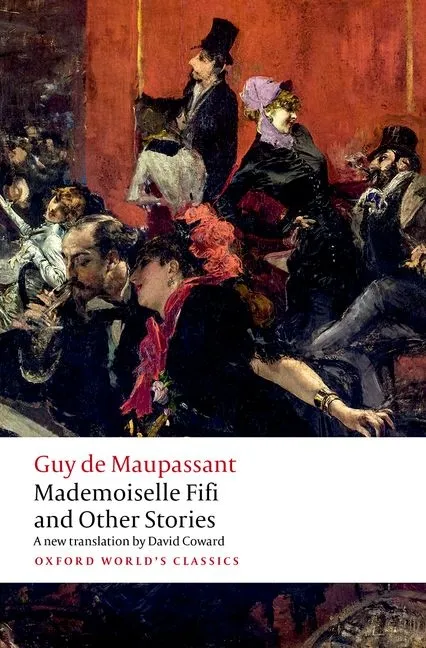
Mademoiselle Fifi and Other Stories
Report an issue
Tell us what's wrong and we'll take a look.
Thanks – we got it. We'll review and follow up if needed.
Maupassant believed that we delude ourselves into believing that we are not animals acting upon instinct but rational creatures capable of idealistic beliefs and actions and survive only on the drug of self-deception. Maupassant's disgust with creation was only equalled by his contempt for human hypocrisy, and in these tales he takes a scalpel to our illusions and cuts to the bone. But his clinical pessimism is redeemed by a sense of the absurd and a warmer compassion for 'humanity bleeding'. Unsentimental but always honest, he persuades us that life is an incomprehensible, cosmic farce.
This translation of twenty tales shows Maupassant at his bitter, bawdy, chilling best. It features some of his grimmest and most famous stories such as A Vendetta and The Grove of Olives, and it also reflects both his moods and his mastery of the short story. The Little Keg is rich in comic invention, while the disturbing Who Can Tell? draws its power from the strange forces which drove its author into madness.
ABOUT THE SERIES: For over 100 years Oxford World's Classics has made available the widest range of literature from around the globe. Each affordable volume reflects Oxford's commitment to scholarship, providing the most accurate text plus a wealth of other valuable features, including expert introductions by leading authorities, helpful notes to clarify the text, up-to-date bibliographies for further study, and much more.
Guy De Maupassant
Guy de Maupassant was a French writer and poet considered to be one of the pioneers of the modern short story whose best-known works include "Boule de Suif," "Mother Sauvage," and "The Necklace." De Maupassant was heavily influenced by his mother, a divorcée who raised her sons on her own, and whose own love of the written word inspired his passion for writing. While studying poetry in Rouen, de Maupassant made the acquaintance of Gustave Flaubert, who became a supporter and life-long influence for the author. De Maupassant died in 1893 after being committed to an asylum in Paris.
More by Guy De Maupassant





Why Readwise Books?
Readwise Books is an ebook & audiobook platform that automatically logs how much you and your friends read, making it fun and easy to read more. Learn more →