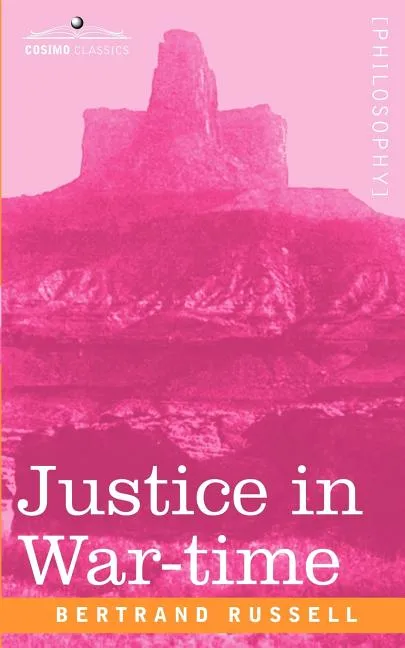
Justice in War-Time
Report an issue
Tell us what's wrong and we'll take a look.
Thanks – we got it. We'll review and follow up if needed.
Justice in War-time, first published in 1916, is a collection of Bertrand Russell's essays on war. He claims that humans have an instinct toward war, but that this instinct needs to be sufficiently roused in order to spark conflict. He analyzes British foreign policy during the ten years before the First World War in an effort to discover how England may have contributed to the problem. The essays included in this volume are: . "An Appeal to the Intellectuals of Europe" . "The Ethics of War" . "War and Non-Resistance" . "Why Nations Love War" . "The Future of Anglo-German Rivalry" . "Is Permanent Peace Possible?" . "The Danger to Civilization" . "The Entente Policy, 1904-1915. A Reply to Professor Gilbert Murray" British philosopher and mathematician BERTRAND ARTHUR WILLIAM RUSSELL (1872-1970) won the Nobel Prize for Literature in 1950. Among his many works are Why I Am Not a Christian (1927), Power: A New Social Analysis (1938), and My Philosophical Development (1959).
Bertrand Russell
Bertrand Arthur William Russell, 3rd Earl Russell was a British philosopher, logician, mathematician, historian, social reformer, and pacifist. Although he spent the majority of his life in England, he was born in Wales, where he also died. Russell led the British “revolt against Idealism” in the early twentieth century and is one of the founders of analytic philosophy along with his protégé Wittgenstein and his elder Frege. He co-authored, with A. N. Whitehead, Principia Mathematica, an attempt to ground mathematics on logic. His philosophical essay “On Denoting” has been considered a “paradigm of philosophy.” Both works have had a considerable influence on logic, mathematics, set theory, linguistics and analytic philosophy. He was a prominent anti-war activist, championing free trade between nations and anti-imperialism. Russell was imprisoned for his pacifist activism during World War I, campaigned against Adolf Hitler, for nuclear disarmament. He criticized Soviet totalitarianism and the United States of America’s involvement in the Vietnam War. In 1950, Russell was awarded the Nobel Prize in Literature, “in recognition of his varied and significant writings in which he champions humanitarian ideals and freedom of thought.”
More by Bertrand Russell


Why Readwise Books?
Readwise Books is an ebook & audiobook platform that automatically logs how much you and your friends read, making it fun and easy to read more. Learn more →