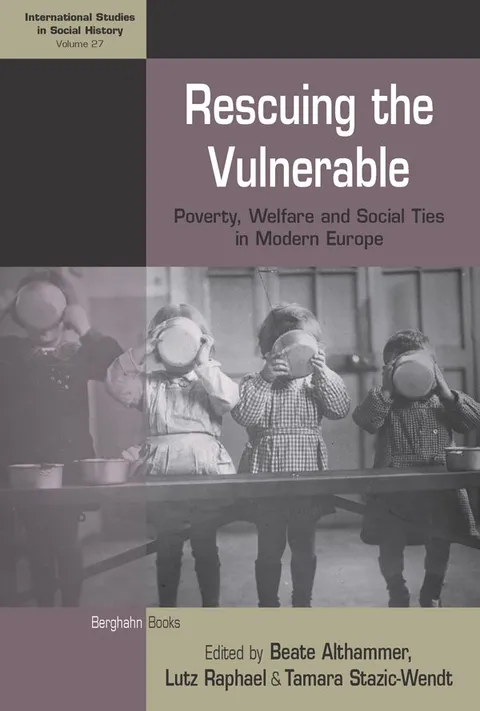
Rescuing the Vulnerable
Poverty, Welfare and Social Ties in Modern Europe
Report an issue
Tell us what's wrong and we'll take a look.
Thanks – we got it. We'll review and follow up if needed.
In many ways, the European welfare state constituted a response to the new forms of social fracture and economic turbulence that were born out of industrialization—challenges that were particularly acute for groups whose integration into society seemed the most tenuous. Covering a range of national cases, this volume explores the relationship of weak social ties to poverty and how ideas about this relationship informed welfare policies in the nineteenth and twentieth centuries. By focusing on three representative populations—neglected children, the homeless, and the unemployed—it provides a rich, comparative consideration of the shifting perceptions, representations, and lived experiences of social vulnerability in modern Europe.
Tamara Stazic-Wendt
Tamara Stazic-Wendt is a doctoral student at the University of Trier and is currently completing her dissertation on unemployment in rural Germany during the interwar period. Her recent publications include "The 'New Morocco' Settlement between Trier and Euren, Germany: Drawing Boundaries and Constructing Deviance, 1925-1933" in The Welfare State and the "Deviant Poor" in Europe, 1870-1933 (2014).


Why Readwise Books?
Readwise Books is an ebook & audiobook platform that automatically logs how much you and your friends read, making it fun and easy to read more. Learn more →