Report an issue
Tell us what's wrong and we'll take a look.
Thanks – we got it. We'll review and follow up if needed.
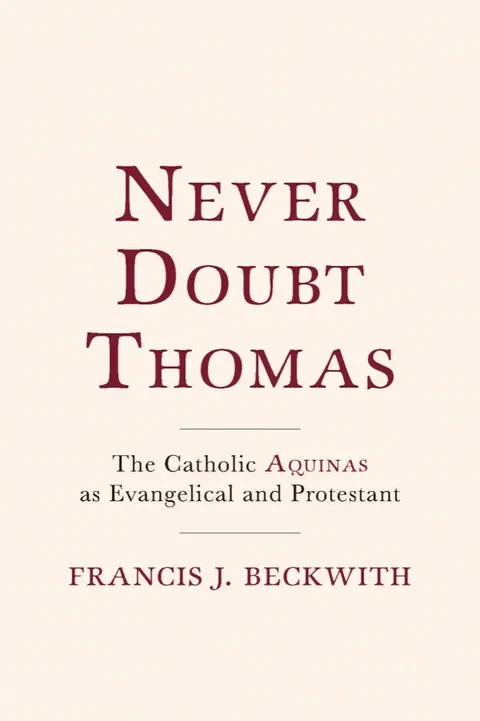
Theologian, philosopher, teacher. There are few religious figures more Catholic than Saint Thomas Aquinas, a man credited with helping to shape Catholicism of the second millennium. In Never Doubt Thomas, Francis J. Beckwith employs his own spiritual journey from Catholicism to Evangelicalism and then back to Catholicism to reveal the signal importance of Aquinas not only for Catholics but also for Protestants. Beckwith begins by outlining Aquinas' history and philosophy, noting misconceptions and inaccurate caricatures of Thomist traditions. He explores the legitimacy of a "Protestant" Aquinas by examining Aquinas' views on natural law and natural theology in light of several Protestant critiques. Not only did Aquinas' presentation of natural law assume some of the very inadequacies Protestant critics have leveled against it, Aquinas did not, as is often supposed, believe that one must first prove God's existence through human reasoning before having faith in God. Rather, Aquinas held that one may know God through reason and employ it to understand more fully the truths of faith. Beckwith also uses Aquinas' preambles of faith--what a person can know about God before fully believing in Him--to argue for a pluralist Aquinas, explaining how followers of Judaism, Christianity, and Islam can all worship the same God, yet adhere to different faiths. Beckwith turns to Aquinas' doctrine of creation to question theories of Intelligent Design, before, finally, coming to the heart of the matter: in what sense can Aquinas be considered an Evangelical? Aquinas' views on justification are often depicted by some Evangelicals as discontinuous with those articulated in the Council of Trent. Beckwith counters this assessment, revealing not only that Aquinas' doctrine fully aligns with the tenets laid out by the Council, but also that this doctrine is more Evangelical than critics care to admit. Beckwith's careful reading makes it hard to doubt that Thomas Aquinas is a theologian, philosopher, and teacher for the universal church--Catholic, Protestant, and Evangelical.
Francis J. Beckwith
Francis J. Beckwith (PhD, Fordham University; MJS, Washington University School of Law, St. Louis) is professor of philosophy and church-state studies and fellow and faculty associate in the Institute for the Studies of Religion at Baylor University. In 2008-9, he served on the faculty of the University of Notre Dame as the Mary Ann Remick Senior Visiting Fellow in Notre Dame's Center for Ethics and Culture. He is the author or coauthor of numerous books, including Defending Life: A Moral and Legal Case against Abortion Choice and To Everyone an Answer: A Case for the Christian Worldview.
More by Francis J. Beckwith



Why Readwise Books?
Readwise Books is an ebook & audiobook platform that automatically logs how much you and your friends read, making it fun and easy to read more. Learn more →