Monetary Policy, Central Banking and Economic Performance in the Caribbean
Report an issue
Tell us what's wrong and we'll take a look.
Thanks – we got it. We'll review and follow up if needed.
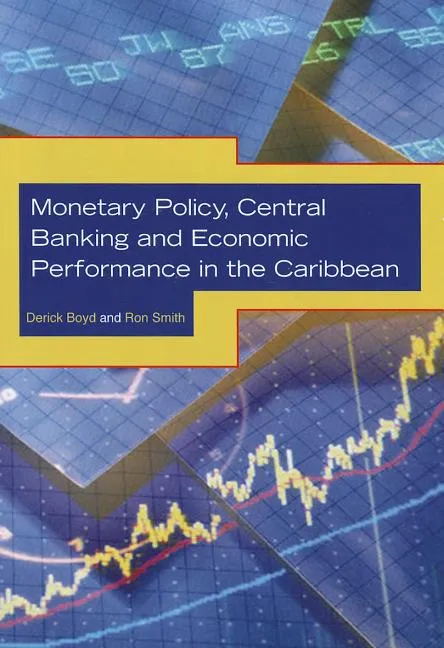
Despite their common British colonial heritage, the twelve Caribbean economies examined in this book exhibit a wide variety of monetary regimes. These include a currency union, currency board, and fixed and floating exchange rate regimes which allow for a range of rules and discretionary-based monetary policies. Derick Boyd and Ron Smith trace the historical origins and evolution of this variety of Caribbean institutions and examine the effect of policy regime on economic performance, using theoretical economic analysis and several econometric techniques, which they explain in detail. Their conclusion is that better economic performance has benefited from an embedded tradition of conservative central banking, either hardwired, as in the case of a currency board, or through discretionary policies, a tradition which seems to have been largely eroded in the resource-rich economies.
Derick Boyd
Derick Boyd is Executive Director of the Caribbean Centre for Money and Finance, University of the West Indies, St Augustine, Trinidad and Tobago, and Reader in Economics, University of East London, where he teaches econometrics and macroeconomics. He was a Fulbright-Hays visiting senior scholar, Massachusetts Institute of Technology, Cambridge, United States, and a former lecturer in economics at the University of the West Indies, Mona, Jamaica.













Why Readwise Books?
Readwise Books is an ebook & audiobook platform that automatically logs how much you and your friends read, making it fun and easy to read more. Learn more →