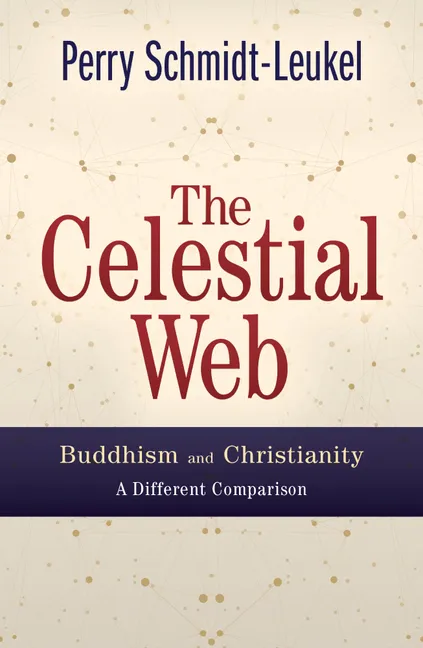
The Celestial Web: Buddhism and Christianity: A Different Comparison
Report an issue
Tell us what's wrong and we'll take a look.
Thanks – we got it. We'll review and follow up if needed.
A leading scholar of religion applies a new method of interfaith understanding to Buddhist-Christian comparative theology providing rich new insights for students and scholars alike.
In his ground-breaking Gifford Lectures, published as Religious Pluralism & Interreligious Dialogue, Perry Schmidt-Leukel introduced his "fractal" theory of religions, challenging the tendency to distinguish religious traditions as discrete entities without acknowledging the wide variety within them, varieties essentially reproduced in different religious traditions.
After offering an introduction to this new methodology to comparative religion, Schmidt-Leukel, in The Celestial Web, applies this method to a comparison between Buddhism and Christianity. Some of the points of comparison include their respective approaches to the world, ultimate reality, the "dark side" of human existence, and salvation/liberation in terms of the figures mediating it.
Stereotypical approaches often treat these traditions as opposites, for instance, positing that Buddhism embraces an impersonal absolute, whereas Christianity affirms the primacy of one's relationship with a personal God. Yet the fractal approach, which examines "intra-religious" varieties within the two traditions, reveals surprising points of congruence.
Perry Schmidt-Leukel
Perry Schmidt-Leukel is Professor of Religious Studies and Intercultural Theology at the University of Muenster, Germany.
More by Perry Schmidt-Leukel


Why Readwise Books?
Readwise Books is an ebook & audiobook platform that automatically logs how much you and your friends read, making it fun and easy to read more. Learn more →