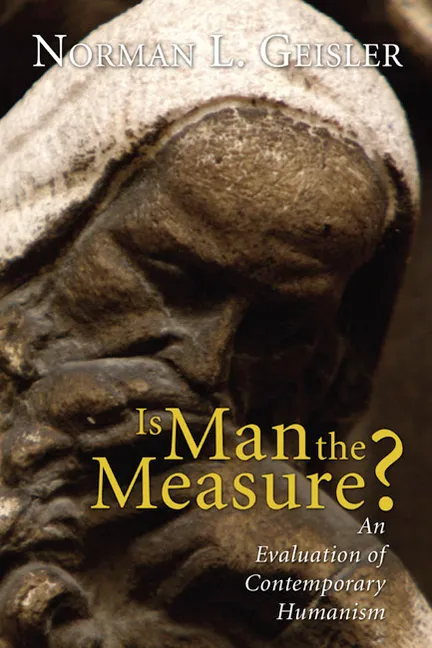
Is Man the Measure?
Report an issue
Tell us what's wrong and we'll take a look.
Thanks – we got it. We'll review and follow up if needed.
An academically respectable description and evaluation of secular humanism is available at last. The diversity within humanism receives full recognition in this book, as does the fact that not everything about humanism is bad from a Christian point of view. Indeed, the author continues, there are many emphases within humanism that are compatible with Christian beliefs, a thesis to which he devotes an entire chapter. Part 1 summarizes in turn eight prominent forms of humanism: Huxley's evolutionism, Skinner's behaviorism, Sartre's existentialism, Dewey's pragmatism, Marxism, Rand's egocentrism, Lamont's culturalism, and the coalitional form present in the humanist declaration and manifestoes. Emerging from these chapters are both the differences between humanists and the consensus that binds them together. It is this humanistic consensus, writes the author, that most radically conflicts with Christian beliefs and that is the number one problem in the United States today. After the chapter on the helpful emphases of secular humanism, part 2 details this movement's comparative inferiority, internal inconsistencies, religious inadequacies, and philosophical insufficiencies. The final chapter demonstrates that, while Christianity is consistent with the central principles of science, philosophy, epistemology, and ethics, humanism is not. There is no rational justification, the author concludes, for being a humanist.
Norman L Geisler
Norman L. Geisler (1932-2019) taught at top evangelical colleges and seminaries for over fifty years and was distinguished professor of apologetics and theology at Veritas Evangelical Seminary in Murrieta, California. He published nearly eighty books over the course of his life, including the Baker Encyclopedia of Christian Apologetics, Christian Ethics, and Systematic Theology.
More by Norman L Geisler


Why Readwise Books?
Readwise Books is an ebook & audiobook platform that automatically logs how much you and your friends read, making it fun and easy to read more. Learn more →