Report an issue
Tell us what's wrong and we'll take a look.
Thanks – we got it. We'll review and follow up if needed.
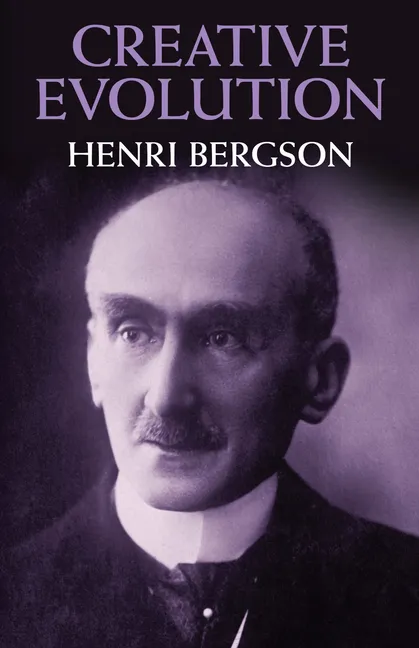
Creative Evolution was published in 1907, and translated into English in 1911. In it, Henri Bergson proposes a version of orthogenesis in place of Charles Darwin's mechanism of evolution, suggesting that evolution is motivated by an élan vital, a "vital impetus," that can also be understood as humanity's natural creative impulse.
In Creative Evolution, Bergson also developed concepts of time which significantly influenced modernist writers and thinkers such as Marcel Proust and Thomas Mann. For example, his term "duration" refers to a more individual, subjective experience of time, as opposed to mathematical, objectively measurable "clock time." He suggests that the experience of time as "duration" can best be understood through intuition.
Discussing the meaning of life, Bergson considers the order of nature and the form of intelligence, including the geometrical tendency of the intellect, and examines mechanisms of thought and illusion. In addition, he presents a critique of the idea of immutability and the concept of nothingness, from Plato and Aristotle through the evolutionism of his contemporaries.
French philosopher Henri-Louis Bergson (1859-1941) was influential in the tradition of continental philosophy, especially during the first half of the 20th century until the Second World War. Bergson is known for his arguments that processes of immediate experience and intuition are more significant than abstract rationalism and science for understanding reality.
He was awarded the 1927 Nobel Prize for Literature "in recognition of his rich and vitalizing ideas and the brilliant skill with which they have been presented." In 1930, France awarded him the Grand-Croix de la Legion d'honneur.
Henri-Louis Bergson
Henri-Louis Bergson (18 October 1859–4 January 1941) was a French philosopher influential in the first half of the 20th century. He believed that for a true understanding of reality the processes of immediate experience combined with intuition play a larger role than rationalism and science. In 1927 he received the Nobel Prize in Literature “in recognition of his rich and vitalizing ideas and the brilliant skill with which they have been presented”. In 1930, he received France’s highest honor: the Grand-Croix de la Legion d’honneur.
More by Henri-Louis Bergson


Why Readwise Books?
Readwise Books is an ebook & audiobook platform that automatically logs how much you and your friends read, making it fun and easy to read more. Learn more →