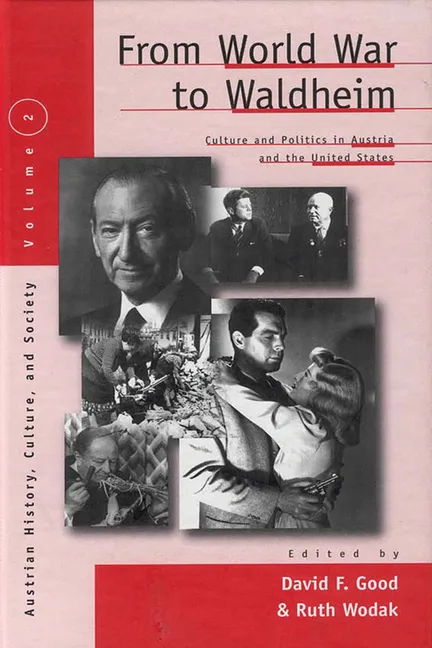
From World War to Waldheim
Culture and Politics in Austria and the United States
Report an issue
Tell us what's wrong and we'll take a look.
Thanks – we got it. We'll review and follow up if needed.
The growing internationalization of the world poses a fundamental question, i.e., through what mechanisms does culture diffuse across political boundaries and what is the role of politics in shaping this diffusion? This volume offers some answers through the case study of the relationship between two quite different states during the Cold War era - Austria, a small neutral country, and the United States, the reigning superpower. The authors challenge naive notions of cultural diffusion that posit the submission of small "peripheral" areas to the dictates of hegemonic powers at the "core." "Americanization" has no doubt taken place since 1945; however, local forces crucially shaped this process, and Austrian elites enjoyed considerable leeway in pursuing "Austrian" political objectives. On the other hand, with the expulsion of Vienna's cultural and intellectual elite after the Anschluß, the United States, more than any othercountry, became heir to the rich cultural legacy of "Vienna 1900," which profoundly shaped politics and culture in both its "high" and popular forms in postwar America. The relationship climaxed and came full circle with the unfolding of the Waldheim affair, which forced Americans and Austrians to reinterpret the meaning of the Nazi era for their own history in a confrontation with the "other."
Ruth Wodak
Ruth Wodak is an Emeritus Distinguished Professor at Lancaster University, UK and the University of Vienna, Austria. She has published widely, including The Politics of Fear: What Right-wing Populist Discourses Mean (2015, Sage).


Why Readwise Books?
Readwise Books is an ebook & audiobook platform that automatically logs how much you and your friends read, making it fun and easy to read more. Learn more →