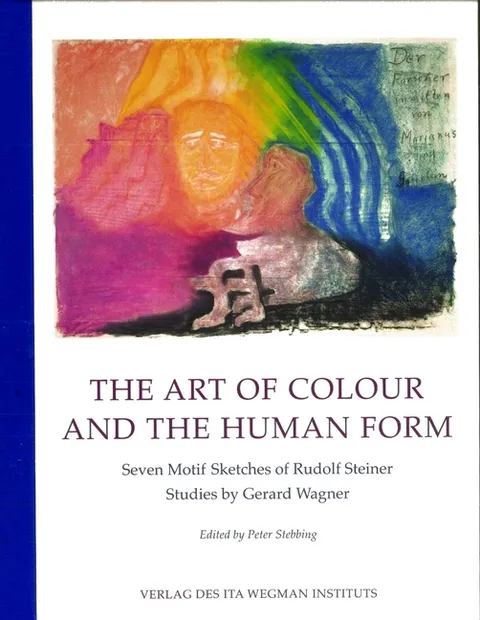
The Art of Colour and the Human Form
Seven Motif Sketches of Rudolf Steiner: Studies by Gerard Wagner
Report an issue
Tell us what's wrong and we'll take a look.
Thanks – we got it. We'll review and follow up if needed.
"...when we speak of visual art...it is above all a matter of understanding how everything in the visual arts ultimately aims at, proceeds from, and creates out of the human form. -- Rudolf Steiner, Becoming Fully Human, p. 43
"The actual underlying problem in painting in our time can be designated as 'depicting the spirit form of the human being out of the color.'" -- Maria Strakosch-Giesler, Die erlöste Sphinx, 1955
Based on Rudolf Steiner's indications, Gerard Wagner shows a wholly new approach to the human form in art. The Art of Colour and the Human Form presents the seven motif sketches concerned with the "spirit form of the human being," as well as numerous studies that Gerard Wagner painted over a period of thirty years. The intention of this volume is to present an artistic approach to these unique motifs and to indicate their potential "color build-up."
The Art of Colour and the Human Form contributes to a more comprehensive understanding of this new direction in art.



Gerard Wagner
Gerard Wagner (1906-1999) was born in Germany and grew up in England. He began his vocation as an artist by learning from an English plein air painter before starting formal studies at the Royal College of Art in London. Beginning in 1926, he took up the challenge of a new direction in painting as initiated by Rudolf Steiner, which became the essence of his life's work for more than seventy years. Through his efforts to grasp the secrets of Steiner's training sketches for painters, Wagner succeeded in disclosing their metamorphic character and, from this, was able to develop a systematic approach to painting. Elisabeth Wagner-Koch, whom Gerard later married, became his first student in 1950, and together they established The Painting School at the Goetheanum, of which he remained the principle teacher until his death in Arlesheim, Switzerland. Rudolf Steiner's indications for an art of the future remained the impulse for Wagner's research and artistic activity throughout his life. The fruits of his research are a unique method of teaching and his archive of paintings, which continue to be a source of inspiration for the school. Wagner's wife Elisabeth cares for the archive of about 4,000 paintings.


Why Readwise Books?
Readwise Books is an ebook & audiobook platform that automatically logs how much you and your friends read, making it fun and easy to read more. Learn more →