Report an issue
Tell us what's wrong and we'll take a look.
Thanks – we got it. We'll review and follow up if needed.
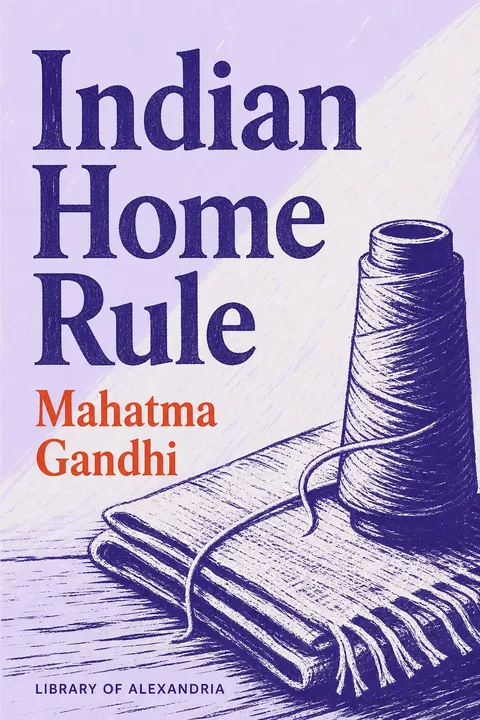
What if independence requires more than replacing one government with another? Gandhi argues that a nation's liberation begins with the way its people live.
Known in Gujarati as Hind Swaraj, Indian Home Rule presents Gandhi's political and moral philosophy through a searching dialogue between an Editor and a Reader. The Reader presses the case for revolutionary violence and Western institutions; the Editor challenges the assumption that either can deliver genuine swaraj. Their exchange turns the struggle against British colonial power into a deeper inquiry into dependence, duty, and self-government.
Gandhi's argument reaches far beyond constitutional change. He questions modern civilization's promises of progress, scrutinizes railways, lawyers, doctors, and machinery, and links national independence to mastery over personal desires and conduct. Alongside these provocative critiques, he considers education, Hindu-Muslim unity, and passive resistance, or soul-force. The dialogue remains compelling because its objections are given a voice: readers are invited to test the relationship between political aims and the means used to pursue them.
What readers find inside:
- The meaning of swaraj - Self-government becomes both a national aspiration and a demand for individual moral discipline.
- Nonviolent resistance - Gandhi explains soul-force through truth, courage, sacrifice, and the refusal to answer violence with violence.
- A challenge to progress - Modern institutions and industrial machinery face searching questions about the dependence they create.
- Unity and education - Religious coexistence and the purposes of learning become central concerns in the struggle for independence.
- Argument in dialogue - The Reader's doubts push the Editor to clarify the ethical foundations of political action.
For readers of political philosophy, students of India's independence movement, and anyone exploring the ethics of nonviolent action, this is a direct encounter with Gandhi's demanding vision of liberation.
Begin the dialogue and consider what it means for a people-and a person-to govern themselves.
Mahatma Gandhi
Mohandas Karamchand Gandhi, was the prominent figure in the freedom struggle in India from the British rule. He is also known as the 'The Father of the Nation', in India. The author has written a number of books and some of them include Character & Nation Building, India of My Dreams, and All Men are Brothers. The author was born on the 2nd of October, 1869, in Porbandar, Gujarat. In the year 1942, he played a key role in launching the Quit India movement, which was intended at forcing the British to leave the nation. As a result of launching this movement, he was thrown in prison and remained there for several years, due to other political offenses allegedly committed by him. At all times, he practised satyagraha, which is the teaching of non-violence. As the British rule ended, he was saddened by India's partition, and tried his best to bring peace among the Sikhs and Muslims. On the 30th of January, 1948, Mahatma Gandhi was shot dead by a Hindu nationalist, for allegedly being highly concerned about the nation's Muslim population.
More by Mahatma Gandhi




Why Readwise Books?
Readwise Books is an ebook & audiobook platform that automatically logs how much you and your friends read, making it fun and easy to read more. Learn more →