Report an issue
Tell us what's wrong and we'll take a look.
Thanks – we got it. We'll review and follow up if needed.
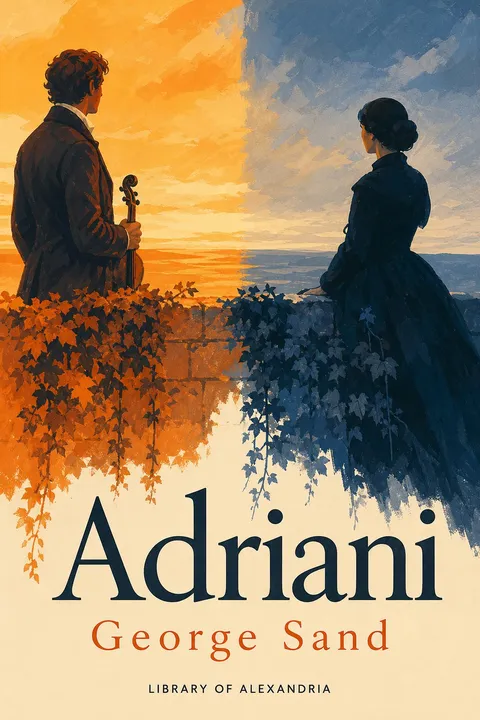
A song breaks the silence between two guarded lives. Can love offer a way forward without betraying what has been lost?
In the valleys of the Ardèche, a celebrated musician travelling without purpose encounters Laure de Monteluz, a young widow whose sorrow has earned her home the name La Désolade. Hearing her sing alone in the dark begins a connection that neither can easily explain. In Adriani, George Sand follows their hesitant approach to one another through music, silence, and conversations shaped as much by fear as by hope.
Letters, diary entries, and intimate narration reveal the distance between what people feel and what they dare to say. For Laure, the possibility of happiness brings the guilt of moving beyond mourning. For Adriani, love is entangled with financial insecurity, professional compromise, and the social prejudices surrounding a performer's place in an aristocratic world. Sand gives these conflicts warmth and moral seriousness, while the observations of servants and companions bring a welcome comic counterpoint. The result is a romance concerned not simply with falling in love, but with finding the strength to live honestly.
What readers find inside:
- A musical courtship - Song becomes a means of connection when ordinary speech cannot express what the lovers feel.
- Grief and renewal - Laure must confront the tension between loyalty to the past and the possibility of a different future.
- Art and social standing - A musician's vocation places personal feeling in conflict with money, reputation, and family expectations.
- Private perspectives - Letters and journals expose hesitation, self-deception, and the risks of emotional candour.
- Quiet comedy - The valet Comtois and the maid Toinette help ground the lovers' intense feelings in everyday life.
This novel will appeal to readers of classic French literature, thoughtful romantic fiction, and stories about artists whose public lives conceal private uncertainty.
Enter Sand's world of music and guarded hearts, and follow a love that asks for courage as well as feeling.
George Sand
George Sand, also known as the pen name Amantine Lucile Aurore Dupin de Francueil, was a French novelist, memoirist, and journalist. Sand was one of the most popular writers in Europe during her lifetime, more well-known than Victor Hugo or Honore de Balzac in England in the 1830s and 1840s, and is regarded as one of the most notable writers of the European Romantic era, having published over 50 volumes of various works, including tales, plays, and political texts, in addition to her 70 novels. George Sand, like her great-grandmother, Louise Dupin, who she idolized, pushed for women, defended desire, condemned marriage, and resisted traditional society's preconceptions. Maurice Dupin de Francueil and Sophie-Victoire Delaborde welcomed Amantine Lucile Aurore Dupin, the future George Sand, into the world on Meslay Street in Paris on July 1, 1804. She was the paternal great-granddaughter of Marshal of France Maurice de Saxe (1696-1750), and her maternal grandpa was Antoine Delaborde, master paulmier and birder.
More by George Sand







Why Readwise Books?
Readwise Books is an ebook & audiobook platform that automatically logs how much you and your friends read, making it fun and easy to read more. Learn more →