Report an issue
Tell us what's wrong and we'll take a look.
Thanks – we got it. We'll review and follow up if needed.
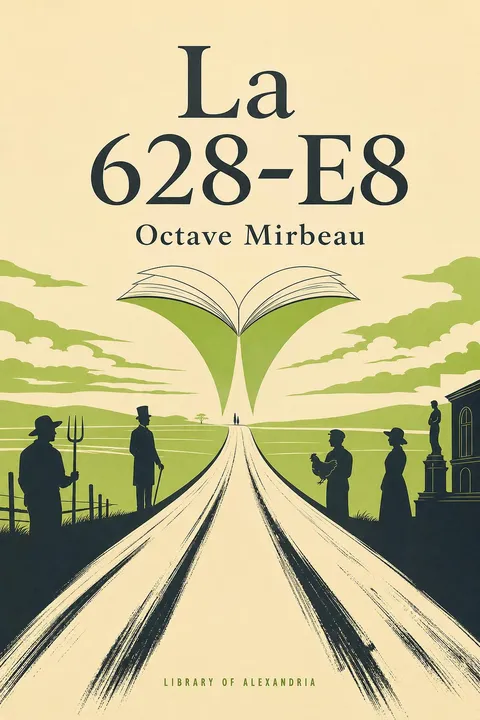
A motorcar opens up Europe-and gives a restless observer a new way to question everything he sees.
In La 628-E8, Octave Mirbeau takes his Charron automobile through France, Belgium, Holland, and Germany, turning a journey into an exuberant experiment in travel writing. Published at the dawn of the motoring age, the book follows not a guidebook's orderly itinerary but the movements of a mind alive to landscapes, strangers, paintings, and the absurdities of respectable society. Memories, dreams, impressions, and inventions share the road.
Mirbeau moves from reflections on Dutch painting to attacks on nationalist pride, from the workings of a Belgian poultry farm to the vulgarity of hotel decoration. His voice can be tender, lyrical, or fiercely mocking, sometimes within the same passage. Behind these changes of direction lies a lasting question: does a new way of moving through the world create a new way of understanding it? The automobile becomes both a practical machine and an imaginative force, unsettling familiar habits of seeing and writing.
What readers find inside:
- Early motoring - A European journey captures the excitement and altered perceptions of travel by automobile.
- Art and landscape - Reflections on Dutch painting explore how artists transform ordinary places in the viewer's imagination.
- Social satire - National vanity, bourgeois hypocrisy, and received ideas meet Mirbeau's pointed wit.
- Unexpected encounters - People glimpsed along the route draw the narrative into comic observations and searching digressions.
- An unconventional form - Recollection, invention, polemic, and lyrical description mingle rather than follow a tidy itinerary.
For readers of literary travelogues, French satire, and the cultural history of technology, this is a journey whose detours are part of its pleasure. Its curiosity about speed, taste, and human behavior still speaks to a world shaped by movement.
Take to the road with Mirbeau and discover how much a passing view can reveal.
Octave Mirbeau
Octave Mirbeau was a French author, art critic, travel writer, pamphleteer, journalist, and playwright who lived from February 16, 1848, to February 16, 1917. He was famous in Europe and had a lot of success with the public. His highly controversial novels about violence, abuse, and psychological detachment were also popular with the literary and artistic avant-garde. Thirty languages have made copies of his work. Mirbeau grew up in the town of Rémalard in Normandy. His grandparents were notaries, and his father was a doctor. He went to a Jesuit college in Vannes for high school, but was kicked out when he was fifteen. Two years after the terrible war of 1870, he was tempted by a call from Dugué de la Fauconnerie, the head of the Bonapartists. He hired him as a private secretary and put him in touch with L'Ordre de Paris. When Mirbeau started writing, it was under his own name. Before that, he worked as a ghostwriter for the Bonapartists and as a journalist for them. For the next few years, he wrote to share his moral and artistic beliefs.
More by Octave Mirbeau



Why Readwise Books?
Readwise Books is an ebook & audiobook platform that automatically logs how much you and your friends read, making it fun and easy to read more. Learn more →