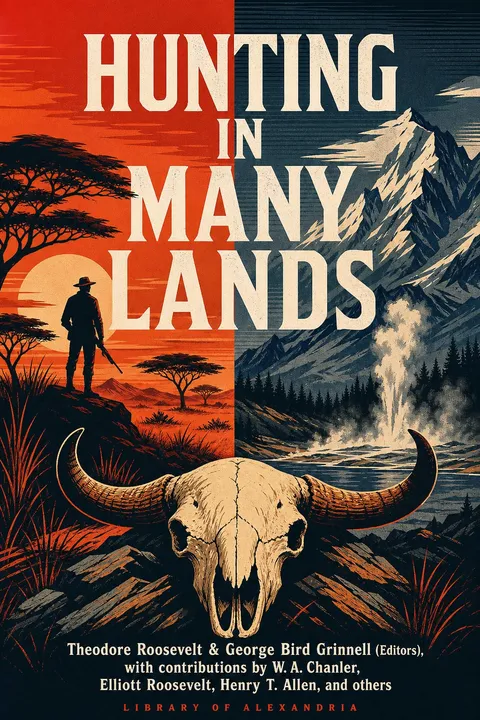
Hunting in Many Lands
Big-Game Adventures and Early Conservation from Africa to the American West
Report an issue
Tell us what's wrong and we'll take a look.
Thanks – we got it. We'll review and follow up if needed.
Across savannas, mountain slopes, and open ranges, the pursuit of big game becomes a story about the future of wildlife itself.
Edited by Theodore Roosevelt and George Bird Grinnell, Hunting in Many Lands is the second volume produced by the Boone and Crockett Club. Its firsthand accounts range from East Africa and India to imperial Russia, Canada, Mongolia, Tibet, and the American West. W. A. Chanler describes encounters with hippopotami and rhinoceroses, Elliott Roosevelt recounts tiger hunting in India, and Henry T. Allen records wolf-hunting with borzois in Russia.
Closer to home, Theodore Roosevelt writes about hunting in the cattle country of the West, while other contributors describe Canadian moose, a Sierra bear pursuit, and the ascent of Chief Mountain in Montana. Alongside these outdoor narratives stand George S. Anderson's account of poaching in Yellowstone and the text of the Yellowstone National Park Protection Act. Read together, the pieces preserve the experiences and assumptions of nineteenth-century sportsmen while showing how their concern for game helped shape a movement for wildlife protection.
What readers find inside:
- International adventures - Hunters describe demanding journeys and encounters with big game across several continents.
- The American West - Roosevelt's cattle-country account captures outdoor life on a range increasingly affected by settlement.
- Field observation - Accounts of terrain, animals, equipment, and pursuit give the narratives their practical texture.
- Yellowstone under threat - The discussion of poaching makes the need for enforceable wildlife protection concrete.
- Conservation's roots - The collection places sporting traditions beside arguments for public stewardship and legal protection.
This book will appeal to readers of historical hunting narratives, students of American conservation, and anyone interested in the outdoor culture of the nineteenth century. It offers both adventure and a revealing record of the relationship between hunting and preservation.
Step into these far-ranging accounts and explore a turning point in the history of wildlife protection.
Theodore Roosevelt
Theodore “Teddy” Roosevelt (1858–1919) was the governor of New York before becoming the vice president of the United States. At age forty-two, Roosevelt became the youngest man to assume the US presidency after President William McKinley was assassinated in 1901. Beloved by the masses, Roosevelt fought for citizen fairness, railroad regulations, and national park conservation. In 1906, Roosevelt received the Nobel Peace Prize for his successful efforts to end the Russo-Japanese War. Besides his active career in politics, Roosevelt was an avid writer, publishing over ninety pieces in his lifetime, including Theodore Roosevelt: An Autobiography, TheNaval War of 1812, and Rough Riders.
George Bird Grinnell
George Bird Grinnell was an American anthropologist, historian, naturalist, and writer. Grinnell wrote many of the first articles dealing with conservation, the protection of the buffalo, and the American West. His book The Fighting Cheyennes was first published in 1915, and he passed away in 1938.


Why Readwise Books?
Readwise Books is an ebook & audiobook platform that automatically logs how much you and your friends read, making it fun and easy to read more. Learn more →