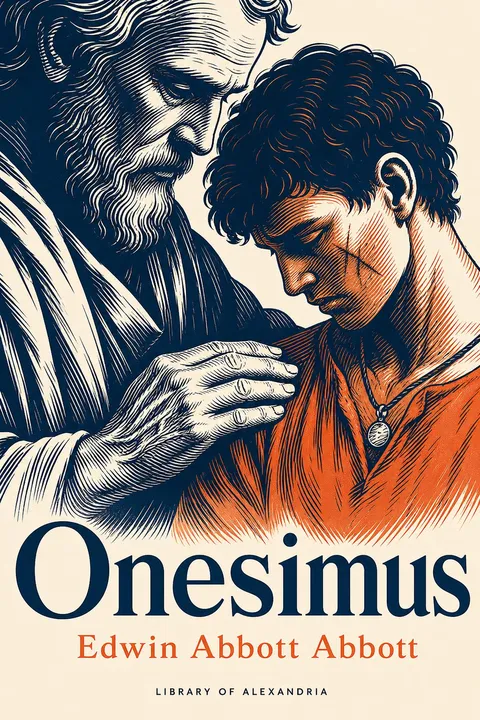
Onesimus
Early Christian Historical Fiction of Slavery, Doubt, and the Search for Faith
Report an issue
Tell us what's wrong and we'll take a look.
Thanks – we got it. We'll review and follow up if needed.
What does it take for a skeptical mind to trust-and for an enslaved man to discover a freedom beyond his master's power?
In Onesimus, Edwin Abbott Abbott gives an imagined life to the man associated with Paul's letter to Philemon. Abandoned as an infant in Pergamus and later sold into slavery, Onesimus moves through a Roman world of pagan worship, philosophical argument, and emerging Christian communities. His journey brings him into the household of Philemon, the intellectual circles of Athens, and the presence of the Apostle Paul.
This is historical fiction in which ideas have personal consequences. Onesimus questions what he hears, distrusts the Christians around him, and struggles with his own pride. Stoicism, skepticism, and Christian teaching offer competing answers to suffering and moral responsibility. As the story extends beyond Paul's death, belief becomes not merely a matter of persuasion but a commitment tested by persecution and loss. Abbott's patient treatment of resistance and conversion gives the novel its continuing interest: spiritual change is neither simple nor painless.
What readers find inside:
- An imagined biblical life - A briefly mentioned New Testament figure becomes the center of a sustained personal and spiritual narrative.
- The Roman world - Asia Minor, Greece, Rome, and Britain provide settings for a journey through servitude, inquiry, and belief.
- Philosophy in conflict - Encounters with Stoic thought and religious skepticism sharpen the questions Onesimus brings to Christianity.
- Faith under pressure - Doubt, pride, suffering, and persecution test the meaning of conversion.
- The early Church - Christian households and communities reveal the challenge of carrying a faith forward after the loss of its first teachers.
For readers of biblical historical fiction, novels of philosophical debate, and stories of spiritual searching, this is an absorbing encounter with the human questions behind early Christian history.
Follow a questioning traveler into the ancient world and discover the difficult path by which conviction becomes a way of life.
Edwin Abbott Abbott
Edwin Abbott Abbott (1838-1926) was an author, schoolmaster, Anglican priest, and theologian. Born in London, he excelled at both the City of London School and St. John's College, taking the highest honors in classics, mathematics, and theology. After retiring as the headmaster of the City of London School (a position he earned at the age of 26) in 1889, he dedicated his life to literary and theological pursuits. Beyond expounding on his open-minded approach to theology, he also wrote a Shakespearean Grammar that is still considered to be a central piece of English philology. He is best remembered for his 1884 novella Flatland: A Romance of Many Dimensions, an evergreen piece of proto-Science Fiction that still inspires authors and readers to this day.
More by Edwin Abbott Abbott







Why Readwise Books?
Readwise Books is an ebook & audiobook platform that automatically logs how much you and your friends read, making it fun and easy to read more. Learn more →