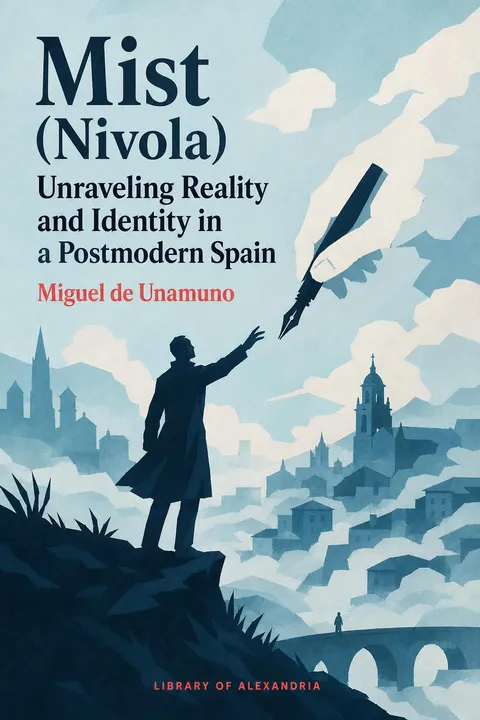
Mist
Philosophical Fiction of Love, Identity, and a Character Who Defies His Creator
Report an issue
Tell us what's wrong and we'll take a look.
Thanks – we got it. We'll review and follow up if needed.
What if the choices you called your own belonged to someone else? For Augusto Pérez, a troubled love affair opens onto a far stranger question: whether he controls his own existence.
First published in 1914, Miguel de Unamuno's Mist, known in Spanish as Niebla, turns a romantic story into an unsettling encounter between character and creator. Augusto is an idle, reflective man whose pursuit of Eugenia draws him out of emotional detachment and into uncertainty. Love promises to give his life direction, yet it also exposes how little he understands himself or the people around him.
Unamuno called the work a nivola, distinguishing his experiment from the conventional novel. Its conversations, irony, and philosophical questioning lead toward the extraordinary confrontation in which Augusto challenges Unamuno himself. Here, the boundary between storytelling and existence becomes the subject of the story. A landmark of Spanish modernist fiction, the book continues to speak to readers who wonder how identity is formed, how much control anyone possesses, and what makes an imagined person feel real.
What readers find inside:
- An uncertain lover - Augusto Pérez searches for purpose through his feelings for Eugenia.
- A rebellious character - A confrontation with his author turns personal anguish into a challenge to narrative authority.
- Existential questions - Love, mortality, and personal agency shape the novel's inquiry into what it means to exist.
- Fiction examining itself - The inventive nivola form makes the relationship between a story and its maker central to the action.
- Humor and unease - Irony complicates the book's serious reflections on desire, self-knowledge, and illusion.
For readers of philosophical novels, Spanish literature, and metafiction, Mist offers both an intimate human predicament and a bold challenge to the rules of storytelling.
Enter Augusto's uncertain world and follow a search for love that becomes a dispute over life itself.


Why Readwise Books?
Readwise Books is an ebook & audiobook platform that automatically logs how much you and your friends read, making it fun and easy to read more. Learn more →