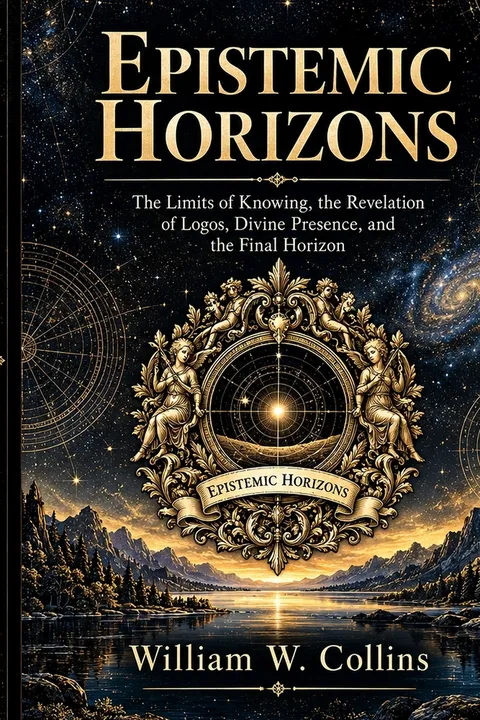
Epistemic Horizons
The Limits of Knowing, the Revelation of Logos, Divine Presence, and the Final Horizon
Report an issue
Tell us what's wrong and we'll take a look.
Thanks – we got it. We'll review and follow up if needed.
What happens when human beings reach not simply the limits of what they know, but the limits of the very categories through which they know?
In Epistemic Horizons: The Limits of Knowing, the Revelation of Logos, Divine Presence, and the Final Horizon, William W. Collins explores that question across four connected essays moving from cosmology and epistemology into revelation, Logos, divine presence, eschatology, and the final destiny of human knowing.
The first essay examines the limits of spacetime-derived concepts such as before, outside, cause, location, and even something and nothing. From this emerges the Epistemic Horizon Effect and the Epistemic Non-Export Principle: the idea that concepts validated within spacetime do not automatically possess jurisdiction over whatever may account for spacetime itself.
The second essay asks how the transcendent could be known if human reason cannot simply cross that horizon on its own. The Christian answer explored here is revelation, with Logos becoming both the ground of creation's intelligibility and the means by which the Creator becomes intelligible to creation.
The third essay traces revelation into presence through creation, covenant, tabernacle, temple, prophetic word, Incarnation, resurrection, and the indwelling Spirit.
The fourth turns toward resurrection, judgment, New Creation, and the transformation of the human knower. Its culminating concept is reconciled finitude: the creature remains finite, yet alienation ends. The horizon is not abolished. Its meaning changes from limitation into inexhaustibility.
For readers wishing to explore the historical lineage, intellectual precedents, and broader philosophical and theological context of the four-essay architecture, those questions are examined separately in Epistemic Horizons: Analytical Companion Guide.
Wilkie Collins
Wilkie Collins (1824–1889) was an English playwright and novelist. A close friend and frequent collaborator of Charles Dickens’s, he is best known as the author of The Moonstone and The Woman in White, “sensation novels” widely recognized as forerunners of modern suspense.
More by Wilkie Collins





Why Readwise Books?
Readwise Books is an ebook & audiobook platform that automatically logs how much you and your friends read, making it fun and easy to read more. Learn more →