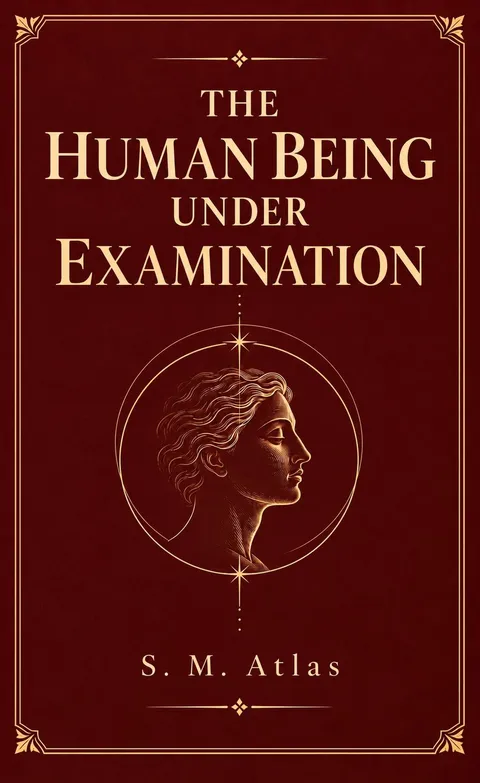
The Human Being Under Examination
Report an issue
Tell us what's wrong and we'll take a look.
Thanks – we got it. We'll review and follow up if needed.
The Human Being Under Examination is a philosophical road map for navigating the confusion, contradiction, and moral uncertainty of modern life.
Human beings have advanced farther than any generation before us. We have built cities, crossed oceans, mapped the stars, transformed medicine, created extraordinary technologies, and gained access to more information than almost any civilization could have imagined. Yet some of the oldest questions remain unresolved.
What makes a person good?
What makes a society just?
What do we owe one another?
What should we do with knowledge once we possess it?
How do we know when progress is truly progress?
What happens when emotion becomes authority, desire becomes identity, or power becomes separated from morality?
And perhaps most importantly: what kind of human beings are we becoming?
S.M. Atlas places humanity itself under examination.
Rather than blaming one nation, race, generation, political movement, religion, or social group for the problems of civilization, the book asks a more uncomfortable question: what if many of the problems we repeatedly see throughout history come from tendencies within human beings themselves?
The book explores morality, empathy, responsibility, war, freedom, knowledge, identity, love, aging, fear, forgiveness, power, history, science, spirituality, and the invisible forces that shape human behavior.
It examines the contradictions within us: our ability to recognize what is right while still choosing what harms us; our desire for freedom while creating systems of control; our compassion toward some people while ignoring the suffering of others; our hunger for knowledge without always possessing the wisdom needed to use it well.
A weapon may defend a family or destroy one.
A technology may save lives or become an instrument of domination.
A person may be disadvantaged in one relationship while benefiting from injustice in another.
A society may condemn the mistakes of the past while quietly rebuilding the same behaviors under different names.
Again and again, the question becomes not simply, "What system failed?" but "What is it within us that keeps rebuilding these systems?"
The book also challenges the way we think about fairness, honor, self-interest, and responsibility. Is winning enough if victory comes through taking advantage of someone else? Is recognizing injustice meaningful if we are unwilling to sacrifice anything to correct it? Is hope enough without action?
It argues that civilizations cannot become better merely by acquiring more information, power, technology, or wealth. Progress without wisdom may simply make humanity more efficient at repeating its oldest mistakes.
Throughout the book, the reader is encouraged to examine assumptions, question inherited beliefs, recognize the limits of observation, and become comfortable admitting, "I may not yet understand enough."
Gradually, the deeper spiritual questions of the human condition emerge: conscience, sacrifice, mercy, grace, truth, and the possibility that humanity's greatest need is not simply better systems, but a better understanding of what a human being is and what a human life is worth.
The Human Being Under Examination is ultimately an invitation to stop moving long enough to ask whether we are moving in the right direction.
It is a guide for the person trying to remain thoughtful in a noisy world, moral in a divided one, compassionate in a cruel one, and grounded in truth when nearly everything around us is competing to define it.
If humanity hopes to find a better path forward, perhaps the first step is not changing the world.
Perhaps it is having the courage to examine ourselves.


Why Readwise Books?
Readwise Books is an ebook & audiobook platform that automatically logs how much you and your friends read, making it fun and easy to read more. Learn more →