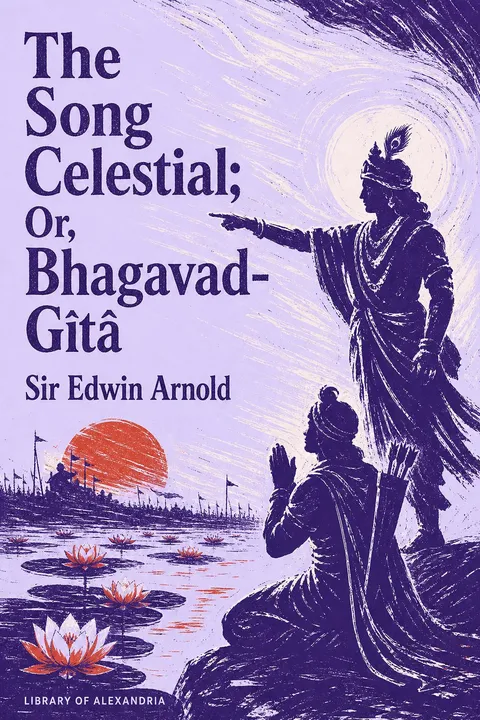
The Song Celestial; Or, Bhagavad-Gîtâ
Hindu Scripture in Verse on Duty, Devotion, and the Eternal Self
Report an issue
Tell us what's wrong and we'll take a look.
Thanks – we got it. We'll review and follow up if needed.
How should we act when duty and feeling pull us in opposite directions? On the threshold of battle, a warrior's anguish opens into a profound inquiry into the soul.
The Song Celestial; Or, Bhagavad-Gîtâ is Edwin Arnold's English verse rendering of the sacred Hindu dialogue embedded in the Mahābhārata. Arjuna, a warrior prince facing the prospect of war against his own kin, turns to Krishna, his charioteer and divine guide. The conversation moves from an immediate moral crisis to questions of action, knowledge, devotion, and the nature of existence.
Krishna's teachings explore dharma, or duty; yoga as spiritual discipline; and liberation from attachment. At their heart is a demanding distinction: acting wholeheartedly need not mean clinging to the results of action. Alongside this teaching stands the vision of an enduring self beyond bodily death. Arnold's lyrical form gives these philosophical ideas a poetic rhythm, preserving the tension between Arjuna's human distress and Krishna's wider spiritual vision. The dialogue has lasted because its questions remain urgent wherever conscience, responsibility, and uncertainty meet.
What readers find inside:
- A crisis of conscience - Arjuna's hesitation makes the battlefield a setting for questions about moral responsibility.
- Selfless action - Krishna explains how to fulfill one's duties without attachment to their rewards.
- The enduring self - The dialogue distinguishes the mortal body from the soul that does not perish.
- Paths of spiritual discipline - Knowledge, action, and devotion offer ways of approaching the divine.
- Poetry and philosophy - Arnold's verse brings a reflective cadence to the exchange between the warrior and his guide.
This work will appeal to readers exploring Hindu sacred writings, lovers of philosophical poetry, and anyone reflecting on the relationship between spiritual conviction and everyday responsibility.
Enter the dialogue and consider what it means to act with purpose without being ruled by the outcome.












Why Readwise Books?
Readwise Books is an ebook & audiobook platform that automatically logs how much you and your friends read, making it fun and easy to read more. Learn more →