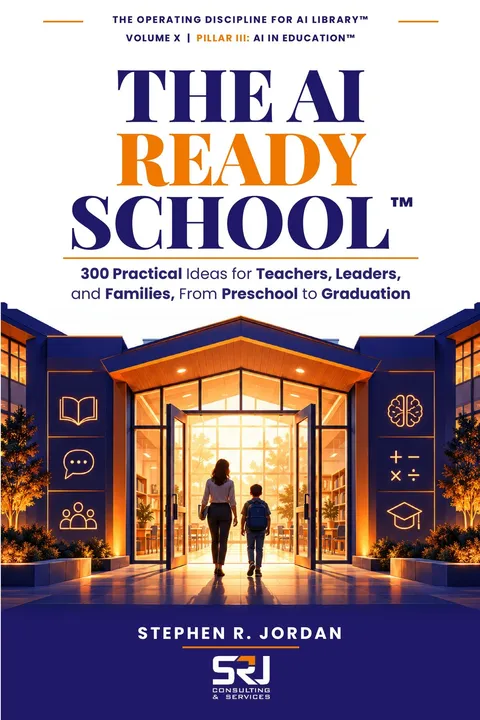
The AI Ready School™
300 Practical Ideas for Teachers, Leaders, and Families, From Preschool to Graduation
Report an issue
Tell us what's wrong and we'll take a look.
Thanks – we got it. We'll review and follow up if needed.
In 2023, nearly 1,000 high school students in Turkey practiced math with a plain chatbot. On a later exam taken without AI, they scored 17 percent worse than students who never used it, because most had simply copied the answers. In Nigeria, students using a similar tool that their teachers set up as a tutor, with teachers in the room, gained 0.31 standard deviations in six weeks. The technology was much the same. The difference was how the adults designed, supervised, and governed its use.
The AI Ready School™ gives teachers, principals, district leaders, school board members, and parents 300 practical ideas for using artificial intelligence well, from preschool through graduation. Each idea is labeled by the strength of its evidence: 17 are Strong, 27 Moderate, 28 Emerging, and 228 Practice. The labels are honest about how young this field is, and they tell readers how much weight each idea can bear.
Five rules run through every chapter. A person makes every decision that affects a student. Student names and details stay out of any tool without a signed data privacy agreement. Tools that help students learn give hints rather than answers. Every AI draft is checked by a person before it is used. And every flag a system raises leads to a person who reaches out.
Part I explains what AI can and cannot do, the ten patterns behind nearly every school use, student privacy under FERPA and COPPA, the human review rule, and a five phase method for piloting a tool, measuring results, and deciding to scale or stop. Part II moves into the classroom: preschool through second grade, reading and writing, mathematics, science and computer science, social studies and world languages, the arts, physical education, health, and tutoring. Part III covers every student and every family: special education, English learners and newcomers, communication with families, wellbeing, behavior, attendance, safety, and counseling for college and career. Part IV addresses running the school: teacher planning and grading, assessment and early warning systems, operations, transportation, finance, and the leadership and culture that decide whether any of it works.
Every chapter ends with the question a school board should ask, the evidence needed to answer it, a common failure pattern, and a Thirty Day Move that needs no new technology. The final chapter lays out the first 90 days for a superintendent, a principal, a teacher, and a parent.
For school leaders and board members, the book shows how to keep an inventory of every AI tool in use, check each contract for what student data it collects and when that data is deleted, and review results every year so that tools which cannot show results are retired.
Some of the strongest findings in the book involve no classroom at all. Weekly messages to families about missed work and grades cut course failures by 27 percent in a randomized trial, and plain, supportive attendance notices outperformed legalistic ones. Many of the best uses of AI in schools are quiet ones that save adults time so they can spend it with students.
Written for busy educators and families, the book uses plain language and short chapters. Products are named only as examples of a pattern, never as endorsements, and no company paid to be included. Research is cited throughout, with a full reference list for readers who want to check the evidence themselves.
Stephen R. Jordan is the founder of SRJ Consulting & Services LLC and the author of The Operating Discipline for AI Library™. He taught computer science and political science at Community Colleges. He lives and works in Frisco, Texas.
This is Volume X of The Operating Discipline for AI Library™ and the first volume of Pillar III: AI in Education™.
Robert Jordan
Robert Jordan was born in 1948 in Charleston. He was a graduate of the Citadel, the Military College of South Carolina, with a degree in physics, and served two tours in Vietnam. His hobbies included hunting, fishing, sailing, poker, chess, pool and pipe collecting. He died in September 2007.
More by Robert Jordan











Why Readwise Books?
Readwise Books is an ebook & audiobook platform that automatically logs how much you and your friends read, making it fun and easy to read more. Learn more →