Report an issue
Tell us what's wrong and we'll take a look.
Thanks – we got it. We'll review and follow up if needed.
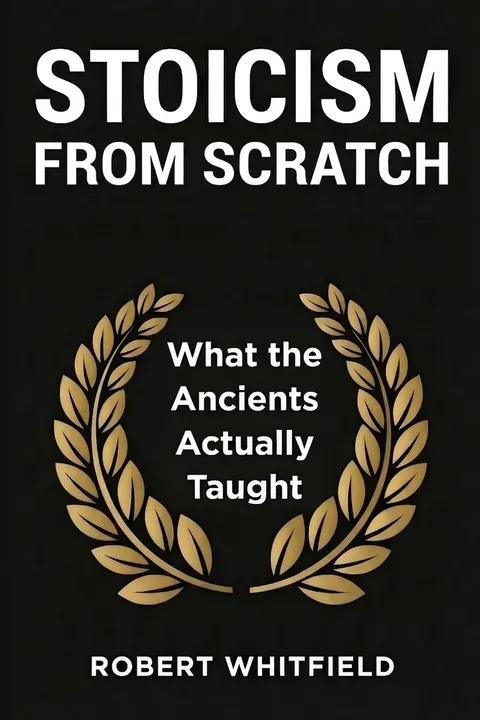
Stoicism is not what the internet made it.
That version is a caricature - and it would have baffled the people who actually built this philosophy: a slave who taught free men how to be free, an emperor who ran the Roman world without letting it go to his head, a writer who was ordered to take his own life and met the moment without flinching. Under slavery, exile, war, and worse, they built a philosophy for people who refuse to be knocked over.
Stoicism from Scratch goes back to what they actually taught - and clears off two thousand years of fog and bad translation to do it. No jargon. No dead words like "virtue" or "temperance" left to mean the opposite of what the Greeks intended.
What you get is the real thing, for someone starting from scratch: how to pull your happiness out of other people's hands, how to want what you already have, how to catch yourself before you react, and how to face loss and your own death honestly.
It's short enough to read in a sitting or two. And it ends with a plan for what to do tomorrow - because understanding this philosophy changes nothing. Only living it does.
If you've tried a Stoicism book before and it felt like a slogan stretched across two hundred pages, this is the one that argues back instead of preaching, tells you the truth, and hands you something you can use tonight.
--------------------------------
Excerpt from - STOICISM FROM SCRATCH: What the Ancients Actually Taught
Start with a fact about yourself that you already half-know.
You are not built to be satisfied. You get the thing you wanted - the phone, the sneakers, the job, the person - and for a little while it is wonderful, and then it goes quiet, and the wanting moves on to the next thing. This is not a personal flaw. It is how human beings are made. There is even a name for it, and psychologists have measured it: they call it hedonic adaptation, which just means you adapt to whatever you get. The new thing becomes the normal thing, the normal thing stops registering, and the hunger relocates.
You have watched this happen your whole life. The jacket you saved up for that felt incredible for a week and then joined the pile. The thing you were sure would make you happy, that made you happy for about as long as a good meal. You already know, somewhere, that the next thing will do the same. And yet you chase it anyway, because in the moment the wanting feels like truth - this one, this time, will be the one that lasts.
But nothing you acquire stays bright, because you adapt to all of it. This is the trap, and almost everyone spends their whole life inside it: running after things that go dim the moment they are caught, then running after the next thing, and the next, and never once stopping to ask why the catching never satisfies....
So do this instead. Take something you have stopped seeing, and imagine it gone.
Picture, concretely, that a friend you take for granted is gone - moved away for good, or dead. Sit in it for a few seconds. Not as a worry about the future, just as a plain fact: this person is no longer in your life. If you actually do it, the invisibility breaks. You see the friend again the way you saw them at the start, before you adapted - and the ordinary next conversation with them becomes something you would not trade for anything.
That is the whole mechanism. You are not manufacturing gloom. You are reversing the adaptation - knocking the wallpaper back into being a person, a gift, a thing you are lucky to have. The Stoics called this negative visualization: picturing the loss of what you have, on purpose, so that you can actually see it while you still have it.
===============================================



Why Readwise Books?
Readwise Books is an ebook & audiobook platform that automatically logs how much you and your friends read, making it fun and easy to read more. Learn more →