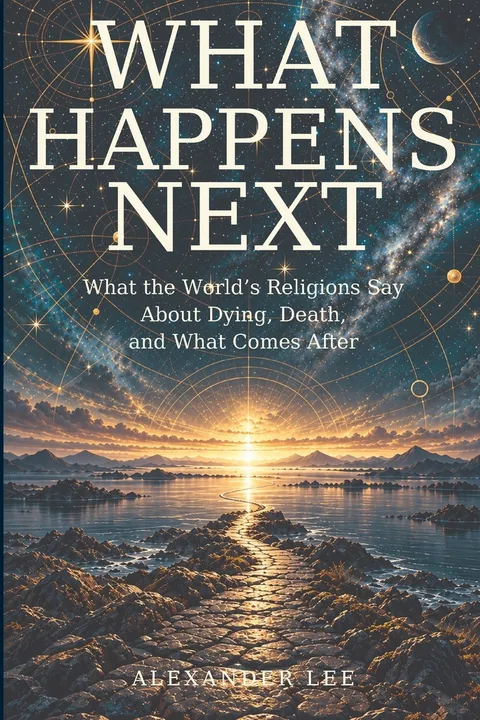
What Happens Next
What the World's Religions Say About Dying, Death, and What Comes After
Report an issue
Tell us what's wrong and we'll take a look.
Thanks – we got it. We'll review and follow up if needed.
Every life ends. The world's religions disagree about what happens next-and what we should do to prepare.
Some traditions describe judgment, others rebirth, reunion with ancestors, or liberation. Many leave detailed instructions for the dying and equally specific responsibilities for the people who remain.
What Happens Next: What the World's Religions Say About Dying, Death, and What Comes After explores these teachings across 49 chapters. Alexander Lee brings together major world religions, Indigenous and ancestral traditions, ancient beliefs, modern spiritual movements, and skeptical perspectives to examine both the possibilities they describe and the practices they ask people to follow.
Each tradition chapter begins with a Quick Guide to its teachings and customs before, during, and after death. An In Depth section then explores the history, sacred texts, stories, and differences within the tradition.
Inside, you'll discover:
How different traditions understand the moment of death and the journey that may follow.
Prayers, rituals, and preparations intended to help the dying and the deceased.
What families can do, which customs require particular care, and whom to contact for guidance.
Perspectives on grief, children and death, planning ahead, and facing mortality without a religious tradition.
Where traditions agree, where they diverge, and how to approach uncertainty.
Drawing on sacred texts, scholarship, and accounts of religious practice, this book describes beliefs without asking readers to accept them as fact or choose one faith over another. It respects the differences between traditions and the authority of each family's own customs.
Whether you are exploring humanity's oldest questions, preparing for your own future, grieving a loss, or sitting beside someone you love, What Happens Next offers a thoughtful guide to what people have believed-and what they have done-when facing the unknown.
Alexander Lee
Alexander Lee is a fellow in the Centre for the Study of the Renaissance at the University of Warwick. Educated at the universities of Cambridge and Edinburgh, he has previously held positions at the universities of Oxford, Bergamo, Luxembourg, Lyon 2 and Lyon 3, amongst others. He is the author of several acclaimed books, including Ghetto: The Jews of Venice, Machiavelli: His Life and Times (a Financial Times and New Statesman ‘Book of the Year’) and Humanism and Empire: The Imperial Ideal in Fourteenth-Century Italy. He writes a regular column for History Today and frequently appears on television, radio, and podcasts. He is a fellow of the Royal Historical Society.
More by Alexander Lee


Why Readwise Books?
Readwise Books is an ebook & audiobook platform that automatically logs how much you and your friends read, making it fun and easy to read more. Learn more →