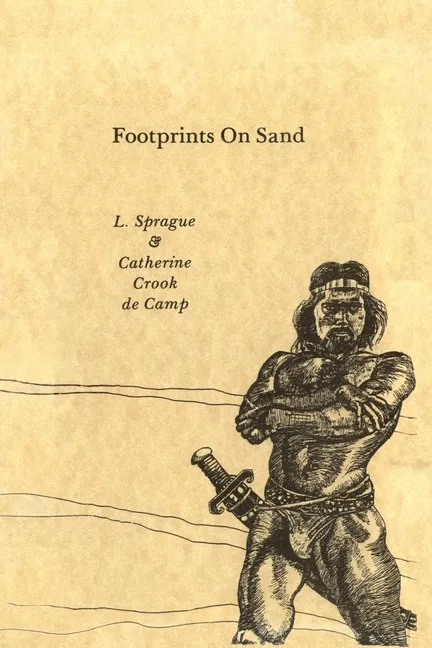
Footprints on Sand
Report an issue
Tell us what's wrong and we'll take a look.
Thanks – we got it. We'll review and follow up if needed.
This collection of the de Camps' work, singly and in collaboration with each other, was assembled in honor of their appearance as joint Guests of Honor at X-Con, June 1981 in Milwaukee.
It is a selection of short stories, verse, non-fiction, and excerpts drawn from almost every facet of the de Camps' diverse writings-fantasy, science fiction, children's stories; poems fabulous, romantic, and pragmatic; notes on prehistory, the evolution of weaponry, and the development of imaginative fiction, the origins of engineering; of Atlantis, Conan, and magic.
This literary feast includes several new pieces, such as Catherine's "Should Your Child Read Science Fiction?" Others range from "The Coming of the Engineers" (LSdeC) to "Windfall" (CCdeC) to "Eudoric's Unicorn" (LSdeC).
Also included are extended introductory remarks about Sprague and Catherine de Camp by Robert A. Heinlein, Lin Carter, Isaac Asimov, Poul Anderson, Andrew Offutt, Patricia Jackson, and George Scithers. The de Camps have passed on since this book was published, and Advent is proud to have it in print as a memorial to them both.
With a color photograph of the de Camps as frontispiece, and black-and-white illustrations by C. H. Burnett.
Also note that some hardback copies are still available direct from the publisher.
L Sprague De Camp
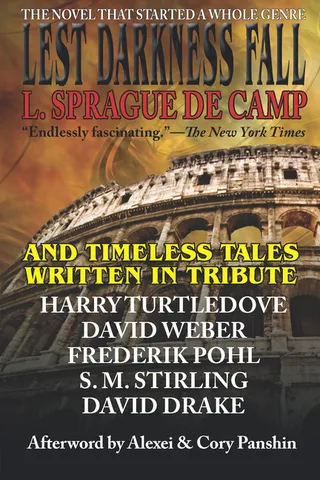
L. Sprague de Camp is a key figure in science fiction and best known for his highly influential book Lest Darkness Fall which not only impacted many future giants of the industry but was responsible for the establishment of alternate history as a solid subgenre. Alternate history has seen a huge increase in popularity in recent years with major media productions like The Man in the High Castle (Amazon's hit series based on the book by Philip K. Dick).
De Camp's body of work is marked by interests in linguistics, ancient history, philosophy, and plausible scientific extrapolation. He wrote several books related to time travel and alternate history which challenged conventional notions of how history is created by arbitrary acts, instead arguing about the importance of technological determination in shaping history. De Camp explored these notions in detail in many of his books, and a number of his books on the subject, including Lest Darkness Fall, are considered seminal works of alternate history and time travel. While the term extraterrestrial was first used by H.G. Wells in connection with life beyond Earth, de Camp is credited with both using it as a noun to describe alien life as well as creating the abbreviation E.T. in the first part of his two-part article, "Design for Life" published in Astounding Science Fiction. Many subsequent bestselling authors in science fiction and fantasy have cited de Camp's work as having a major influence on them, including David Weber, David Drake and Frederik Pohl. L. Sprague de Camp was a guest of honor at the 1966 World science fiction convention, was named a Gandalf Master of Fantasy at the 1976 convention (after J.R.R. Tolkien and Fritz Leiber) and a Grandmaster of Science Fiction by the Science Fiction Writers of America (SFWA) in 1979. He also accumulated a plethora of awards, including a Special Achievement Sidewise Award for Alternate History in 1996, citing "seminal works in the field." He was born in New York City in 1907 and married Catherine Adelaide Crook in 1939. They moved to Plano, Texas in 1989. Both he and Catherine died within months of each other in 2000. Their ashes share a columbarium niche together at Arlington National Cemetery.More by L Sprague De Camp



Why Readwise Books?
Readwise Books is an ebook & audiobook platform that automatically logs how much you and your friends read, making it fun and easy to read more. Learn more →