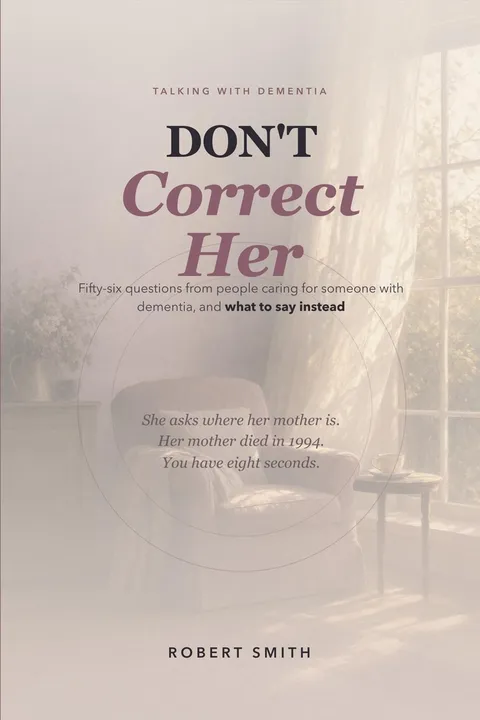
Don't Correct Her
Talking With Dementia: 56 Questions From People Caring For Someone With Dementia, and What to Say Instead
Report an issue
Tell us what's wrong and we'll take a look.
Thanks – we got it. We'll review and follow up if needed.
The instinct is to tell the truth, because you have never lied to her. So you say it, and you watch her receive the news of her mother's death for what is, to her, the first time. And forty minutes later she asks again.
There is no arrangement in which she is both comfortable and correctly informed. The exhausting part is not the caring. It is making that decision forty times a day, alone, with nobody to ask.
This is not a book about dementia. It says nothing about the condition, the stages, the treatments, or the care decisions. It is about what to say, in the specific moment, when the thing you were about to say is going to make it worse.
Fifty-six questions, each answered in three parts: why it is happening, what to say, and what not to say. Find yours in the contents. Read three pages. Go to bed.
Among them:
- She says she wants to go home. She is at home.
- She does not know who I am.
- She says I have stolen her things.
- She is trying to collect children who are now fifty.
- She will not wash. She will not eat. She is up at three in the morning.
- She only wants my brother, who never visits.
- She was never kind to me, and now I care for her.
- Someone has died and she does not know.
- I shouted at her. I resent her. Sometimes I want it to be over.
It takes a position and says so. Prioritise her emotional reality over the factual record, almost always. And it is honest that this is genuinely contested: two peer-reviewed papers on the ethics of therapeutic lying are cited and discussed, including the argument against, because the discomfort you feel about it is a reasonable response to an unresolved question.
There is a chapter for the caregiver on every page that needs one, and eight at the end on shouting, numbness, resentment, guilt, and grieving somebody who is still alive.
This book contains no medical advice. It does not diagnose, treat, or make any claim about the course of any condition.
Whatever happened today, you are doing this better than you think you are.







Why Readwise Books?
Readwise Books is an ebook & audiobook platform that automatically logs how much you and your friends read, making it fun and easy to read more. Learn more →