Report an issue
Tell us what's wrong and we'll take a look.
Thanks – we got it. We'll review and follow up if needed.
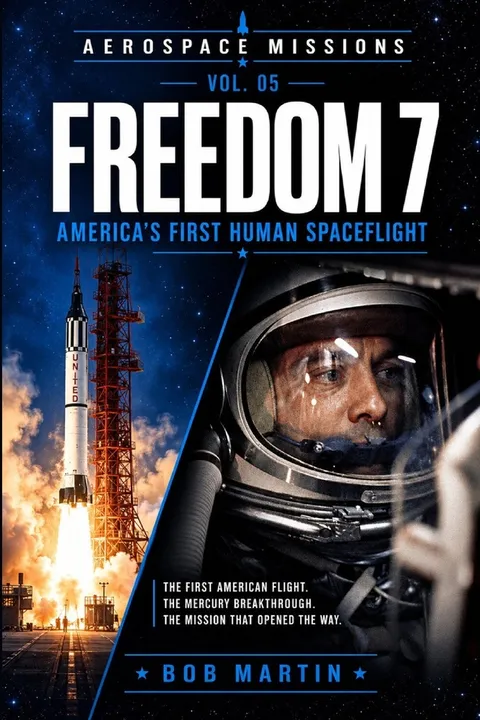
Some missions matter because of how far they traveled. Others matter because they proved an entire system could work. In just over fifteen minutes, one astronaut, one capsule, and one modified missile carried the United States across the threshold into human spaceflight.
Freedom 7: America's First Human Spaceflight
On May 5, 1961, Alan Shepard became the first American to travel into space. Behind that brief suborbital flight stood years of engineering, testing, failure analysis, astronaut training, political pressure, and difficult decisions about how much control a human being should have inside a spacecraft.
Written in Bob Martin's authoritative, technically informed style, Freedom 7 takes you inside Project Mercury and shows how America's first crewed spaceflight was actually made possible-from the selection and preparation of Shepard to the Mercury capsule, the human-rated Redstone booster, the escape system, mission procedures, recovery planning, and the lessons learned from the flights that came before him.
Inside, you will discover:
- How Mercury-Redstone evolved into a human-rated launch system, and why seemingly small engineering changes could determine whether an astronaut returned safely.
- The remarkable test program before Shepard, including the extraordinary MR-1 pad failure, Ham's demanding MR-2 flight, and the additional mission NASA insisted on before committing a man.
- What Shepard actually did during those fifteen minutes, including manual spacecraft control, weightlessness, the periscope system, retrofire, reentry, and the physical demands of the flight.
- The lesser-known decisions and operational details behind the familiar story, from astronaut competition and Gagarin's impact on the American schedule to cockpit realities, recovery operations, and what engineers learned after Freedom 7 returned.
The result is a mission history built for readers who want to understand the people, machinery, risks, and engineering logic behind the milestone.
For aerospace enthusiasts, aviation-history readers, engineers, collectors, and anyone fascinated by the origins of American human spaceflight, Freedom 7 offers a deeper understanding of the mission that helped turn Project Mercury from an experimental program into a working path toward orbital flight, Gemini, Apollo, and the Moon.






Why Readwise Books?
Readwise Books is an ebook & audiobook platform that automatically logs how much you and your friends read, making it fun and easy to read more. Learn more →