Report an issue
Tell us what's wrong and we'll take a look.
Thanks – we got it. We'll review and follow up if needed.
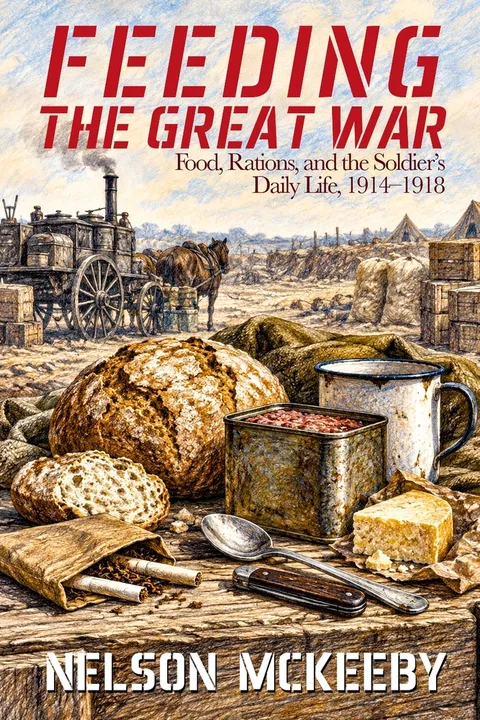
Every army in the First World War faced the same daily problem: millions of soldiers had to be fed, wherever the war carried them.
Feeding the Great War follows that food from farm, factory, slaughterhouse, bakery, railway, wagon, and field kitchen to the soldier waiting at the end of the supply line. It examines the ration systems of the Austro-Hungarian, British, French, German, Italian, Ottoman, Russian, and United States armies, showing what regulations promised, what quartermasters attempted to provide, and what men actually received when distance, weather, transport, shortages, and enemy action intervened.
Bread came from enormous military bakeries and portable ovens. Meat arrived fresh, frozen, salted, or sealed in tins. Rolling kitchens turned bulk provisions into soup and stew, while hard biscuit, canned beef, coffee, tea, sugar, chocolate, tobacco, and preserved vegetables kept men going when the ordinary supply system failed. Behind even the simplest meal stood railways, horses, trucks, bakers, butchers, cooks, ration parties, and an industrial organization stretching hundreds or thousands of miles behind the front.
The book also follows the ration as the war changed it. Blockade, declining harvests, lost farmland, submarine warfare, exhausted transport systems, and the demands of armies numbering in the millions replaced familiar foods with substitutes and steadily widened the distance between the official ration and the food in a soldier's mess tin.
This is the Great War seen through bread, beef, coffee, tobacco, vegetables, and the enormous machinery required to put them into a soldier's hands. http: //virdea.net/














Why Readwise Books?
Readwise Books is an ebook & audiobook platform that automatically logs how much you and your friends read, making it fun and easy to read more. Learn more →