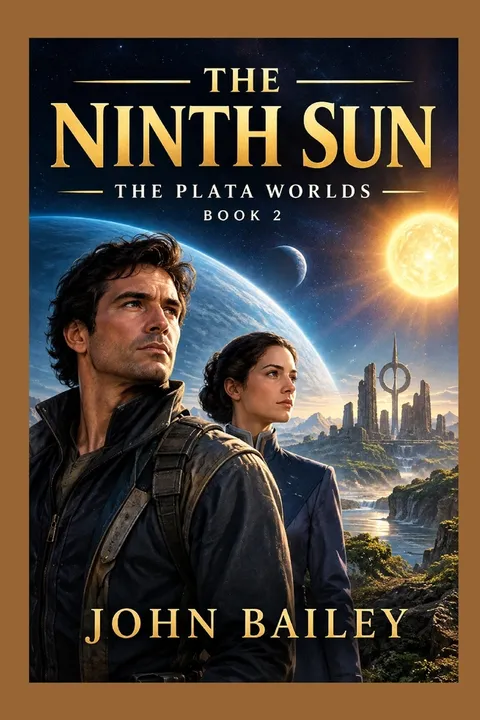
The Ninth Sun
Report an issue
Tell us what's wrong and we'll take a look.
Thanks – we got it. We'll review and follow up if needed.
At least, that is what the astronomers say.
Six hundred years ago, a vast interstellar network known as the Roads connected distant worlds. Then came the Fires-catastrophic events that destroyed nodes, severed connections, and left entire civilizations isolated. The Plata Worlds survived, but their people eventually forgot that they had once been part of something much larger.
Now the Roads have been partially restored.
And someone-or something-is still waiting at the other end.
Mateo Salazar has spent months trying to keep five suspicious governments from turning the discovery at Xochicuzmal into a war. Then astronomers identify the destination marked on an ancient chart as the Ninth Sun: a star that died centuries ago.
There should be nothing there.
Instead, a precise signal has been transmitting from the darkness around the dead star for generations.
The mystery deepens when historian Arriaga reveals that the Roads have been discovered before-and that every previous rediscovery ended badly. A forgotten intelligence file, an expedition that vanished centuries ago, and the name Iñigo Varela point toward a history the Plata Worlds have misunderstood.
Five governments must now agree to something unprecedented: explore the Ninth Sun without claiming it, exploiting its technology, or turning its discoveries into weapons.
But reaching the dead star is only the beginning.
Beyond the failed gateway lies an ancient city, a people who have kept an impossible promise for six centuries, and evidence that the civilization the Plata Worlds believed destroyed may have survived after all.
The Ninth Sun is a science-fiction mystery about forgotten history, dangerous knowledge, political trust, and the consequences of discovering that your civilization is only one fragment of a much larger story.
John Bailey
John Bailey gained his PhD at Leicester University on Japanese Knotweed and its hybrids, co-supervised by Ann Conolly and Clive Stace, which established the cytological basis of the genus. He has since travelled extensively on knotweed research activities and speaking at conferences. With the aid of three PhD students, he took advantage of new DNA technologies to further elucidate population structure, evolution and phylogeny of the genus Reynoutria. He has contributed to more than 40 scientific papers on the subject and has a current h-index of 36.
More by John Bailey



Why Readwise Books?
Readwise Books is an ebook & audiobook platform that automatically logs how much you and your friends read, making it fun and easy to read more. Learn more →