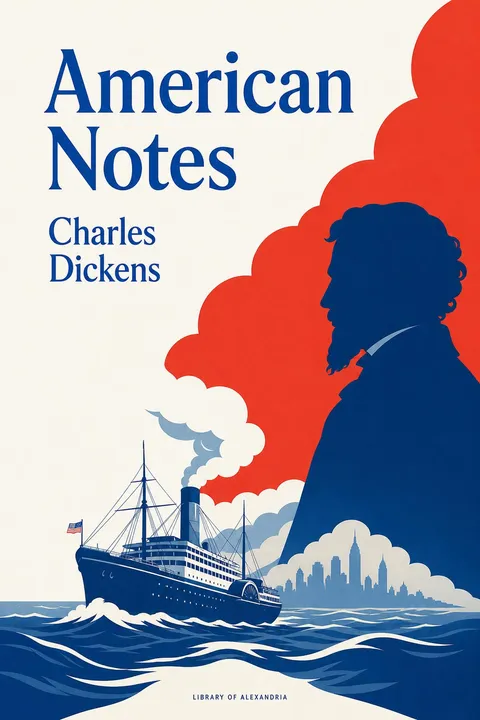
American Notes: Travel Writing From 19th-Century America
Democracy and Its Contradictions
Report an issue
Tell us what's wrong and we'll take a look.
Thanks – we got it. We'll review and follow up if needed.
What happens when a celebrated visitor looks beyond a nation's welcome to examine how it treats its most vulnerable people?
In American Notes, Charles Dickens records his 1842 journey through the United States with curiosity, humor, and an increasingly critical eye. Boston and New York, public institutions, crowded journeys, and encounters with American manners supply the material for a travel narrative that moves between delight and dismay. His attention falls not only on impressive sights, but on the habits and institutions through which a society reveals its values.
Dickens approaches American democracy with high expectations, then measures its ideals against what he observes. His visits to prisons and institutions for the poor raise questions about dignity and punishment, while slavery draws his forceful condemnation. The result is both a vivid record of a particular historical moment and a revealing encounter between British expectations and American life. Its lasting interest lies in that tension: an energetic, ambitious nation seen by a writer unwilling to let public confidence settle difficult moral questions.
What readers find inside:
• Cities and Encounters - Boston and New York offer occasions for close observation of public life and social customs.
• Democracy Under Scrutiny - The distance between national ideals and lived conditions gives the journey its central tension.
• Prisons and Poverty - Visits to institutions turn attention toward the treatment of people at society's margins.
• A Condemnation of Slavery - Dickens confronts an institution fundamentally at odds with the nation's democratic claims.
• Wit and Moral Concern - Comic observation and vivid description sit alongside serious questions about human compassion.
This book will appeal to readers of classic travel writing, anyone interested in nineteenth-century American social history, and admirers of Dickens seeking his nonfiction voice.
Join Dickens on a journey that asks what a nation's everyday practices reveal about its promises.
Charles Dickens
Charles Dickens was born in 1812 near Portsmouth where his father was a clerk in the navy pay office. The family moved to London in 1823, but their fortunes were severely impaired. Dickens was sent to work in a blacking-warehouse when his father was imprisoned for debt. Both experiences deeply affected the future novelist. In 1833, he began contributing stories to newspapers and magazines, and in 1836 started the serial publication of The Pickwick Papers. Thereafter, Dickens published his major novels over the course of the next twenty years, from Nicholas Nickleby to Little Dorrit. He also edited the journals Household Words and All the Year Round. Dickens died in June 1870.
More by Charles Dickens




Why Readwise Books?
Readwise Books is an ebook & audiobook platform that automatically logs how much you and your friends read, making it fun and easy to read more. Learn more →