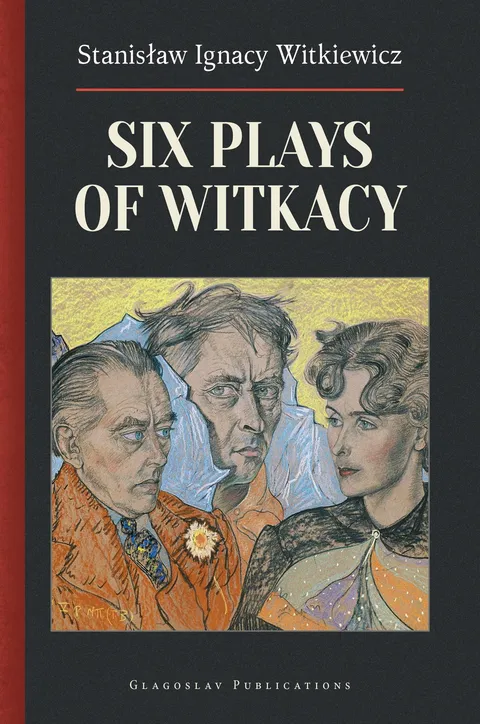
Six Plays of Witkacy
Report an issue
Tell us what's wrong and we'll take a look.
Thanks – we got it. We'll review and follow up if needed.
A hunchbacked Richard III sits in a Gothic hall, guarded by masked murderers. A dead wife walks back into her manor house to settle accounts with the living. Pope Julius II argues about art with a painter who wants nothing to do with him. A poet locked in a madhouse falls in love with the nun sent to calm him. A cobbler and his apprentices start a revolution while a duchess with bat wings looks on.
Stanisław Ignacy Witkiewicz, known as Witkacy, wrote these plays between 1920 and 1934 for a theatre that did not yet exist. They grow out of his theory of Pure Form, which held that a play should move its audience the way a painting does, through the shape of the whole rather than the logic of the plot. The result is farce, metaphysics, nightmare and cabaret at once, and it reached the territory of the Theatre of the Absurd decades before Ionesco and Beckett got there.
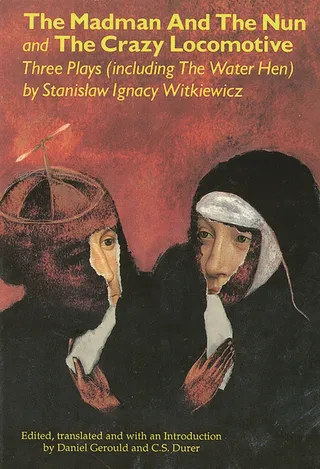
This collection brings together The New Deliverance, In the Manor, Cuttlefish, The Madman and the Nun, The Mother and Cobblers. Adam Czasak translated them from Witkacy's manuscripts and first editions, and his introduction and notes guide the reader through the life, the ideas and the language of one of the strangest and most original writers of twentieth-century Europe.
Stanislaw Ignacy Witkiewicz
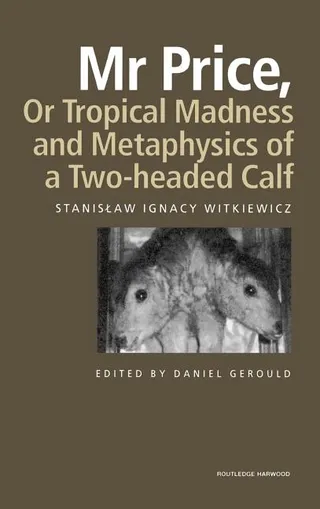
Stanislaw Ignacy Witkiewicz (1885-1939), known as Witkacy, was a playwright, novelist, painter, photographer and philosopher, and one of the most original figures of the European avant-garde. He was born in Warsaw on 24 February 1885, the son of the painter and critic Stanislaw Witkiewicz, creator of the Zakopane style. From 1890 the family lived in Zakopane, where the boy was educated at home according to his father's unorthodox principles and wrote his first plays as a child.He studied painting at the Kraków Academy of Fine Arts and travelled widely in Western Europe. In 1914, after the suicide of his fiancée, he joined the anthropologist Bronislaw Malinowski on an expedition that took him to Ceylon and Australia. When war broke out he went to St Petersburg, served as an officer in the Pavlovsk Regiment and witnessed the revolutions of 1917 at first hand.Back in Poland in 1918, he settled in Zakopane, exhibited with the Formists and set out his theory of Pure Form in New Forms in Painting (1919) and Theatre (1923). In the space of a few years he wrote more than two dozen plays, among them The Madman and the Nun and The Mother, though very few reached the stage in his lifetime; Cobblers, his last great play, followed in 1934. His novels Farewell to Autumn and Insatiability are dark visions of a civilisation sliding into mechanised uniformity, and his philosophy culminated in Concepts and Theorems Implied by the Concept of Being (1935). He earned his living through the tongue-in-cheek Portrait Company, whose pastels are now prized by museums and collectors alike.On 18 September 1939, the day after the Soviet army crossed Poland's eastern border, Witkacy took his own life in the village of Jeziory. Largely forgotten after the war, he was rediscovered during the political thaw of the 1950s. Today he is regarded as a forerunner of the Theatre of the Absurd, and his plays are staged around the world.
More by Stanislaw Ignacy Witkiewicz

Adam Czasak
Translated by
Adam Czasak was born in England of Polish parents. He studied Polish Philology at the Jagiellonian University, and English at the University of Ulster and University College London. He lives in Kraków.


Why Readwise Books?
Readwise Books is an ebook & audiobook platform that automatically logs how much you and your friends read, making it fun and easy to read more. Learn more →