Report an issue
Tell us what's wrong and we'll take a look.
Thanks – we got it. We'll review and follow up if needed.
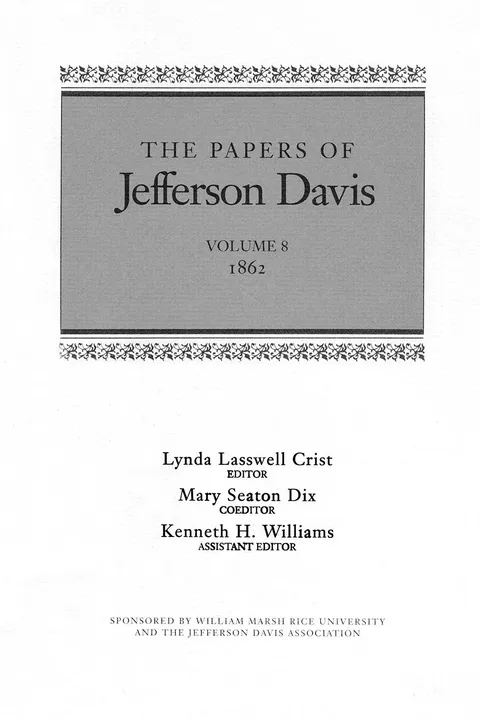
Volume 8 of The Papers of Jefferson Davis brings the Confederate president to the second year of the War Between the States and shows that during 1862 Davis was almost completely overwhelmed by military matters. Indeed, early that year, in an address to the Confederate Congress, he admitted that in trying to defend every part of its far-flung territory, the “Government had attempted more than it had power successfully to achieve.”
During 1862, Judah P. Benjamin was replaced as secretary of war by George W. Randolph, who was then succeeded by James A. Seddon. As the year advanced, Davis’ relationships with certain key generals continued to sour. Chief among them were P.G.T. Beauregard, who was finally removed from his last significant command, and Joseph E. Johnston, whose fall from grace precipitated Robert E. Lee’s rise to influence as commander of the Army of Northern Virginia. Lee proved to be as adept in communicating and coordinating plans with the president as Johnston had been inept.
At the inconclusive Battle of Shiloh, Davis lost Albert Sidney Johnston, a trusted friend and the general he had most admired. Like Shiloh, many other campaigns of 1862 ended in stalemate and withdrawal, including Henry H. Sibley’s New Mexico campaign, Braxton Bragg’s Kentucky campaign, Earl Van Dorn’s battle at Elkhorn Tavern, and the Confederacy’s greatest gamble—Lee’s Invasion of Maryland.
Correspondence with Davis’ brother, Joseph E. Davis, reveals the ever-worsening situation in Mississippi. The Federal occupation of New Orleans, the fall of new Madrid and Island No. 10, and Grants repeated attempts to capture Vicksburg heightened anxiety about the area and persuaded the president to tour the western theater in December.
Because the Union’s springtime invasion of Richmond prompted Davis to send his wife and children away, Volume 8 contains an unusually rich collection of letters exchanged during their separation. This correspondence offers a rare glimpse into the minds and hearts of Davis and his wife.
Altogether, more than 2,000 documents, many never before published, are included in Volume 8; 133 are printed in full. Culled from fifty-nine repositories, twenty-one private collections, and numerous printed sources, they reveal that despite the many setbacks he suffered in 1862, Davis maintained a deep devotion to duty and an unbending will to win.
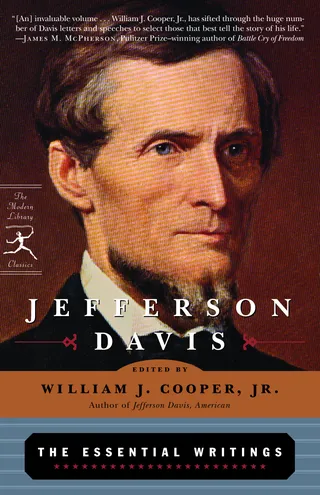
Jefferson Davis
Jefferson Davis was an American soldier and politician, but is best known for being the only president of the Confederate States of America. Educated as a soldier at the U.S. Military Academy at West Point, Davis served two tours of military service, first during the Black Hawk War in 1832 and later during the Mexican-American War from 1846-48. Following the Mexican-American War, Davis was appointed to the United States Senate, and later served as secretary of war to President Pierce. Although Davis, as a senator, had argued against secession, he resigned his role in the federal government and returned to his home state of Mississippi following that state’s successful succession vote, and was acclaimed president of the Confederate States of America in 1861.
At the end of the American Civil War in 1865, Davis was captured and accused of treason, and his citizenship was revoked. Davis’s 1881 memoir, The Rise and Fall of the Confederate Government did much to restore his reputation, as did his efforts to encourage reconciliation, however, his citizenship was not restored until 1978. Jefferson Davis died in 1889.
More by Jefferson Davis


Why Readwise Books?
Readwise Books is an ebook & audiobook platform that automatically logs how much you and your friends read, making it fun and easy to read more. Learn more →