Report an issue
Tell us what's wrong and we'll take a look.
Thanks – we got it. We'll review and follow up if needed.
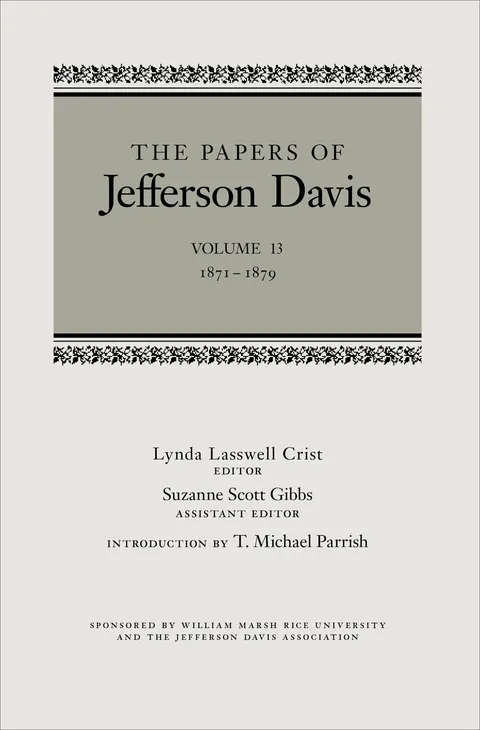
Volume 13 of The Papers of Jefferson Davis follows the former president of the Confederacy as he becomes head of the Carolina Life Insurance Company of Memphis and attempts to gain a financial foothold for his newly reunited family. Having lost everything in the Civil War and spent two years immediately afterwards in federal prison, Davis faced a mounting array of financial woes, health problems, and family illnesses and tragedies in the 1870s. Despite setbacks during this decade, Davis also began a quest to rehabilitate his image and protect his historical legacy.
Although his position with the insurance company provided temporary financial stability, Davis resigned after the Panic of 1873 forced the sale of the company and its new owners canceled payments to Carolina policyholders. He left for England the following year in search of employment and to recuperate from ongoing illnesses. In 1876, Davis became president of the London-based Mississippi Valley Society and relocated to New Orleans to run the company.
Throughout the 1870s, Davis waged an expensive and seemingly endless legal battle to regain his prewar Mississippi plantation, Brierfield. He also began working on his memoirs at Beauvoir, the Gulf Coast estate of a family friend. Though disfranchised, Davis addressed the subject of politics with more frequency during this decade, criticizing the Reconstruction policies of the federal government while defending the South and the former Confederacy. The volume ends with Davis's inheritance of Beauvoir, which was his last home.
The editors have drawn from over one hundred manuscript repositories and private collections in addition to numerous published sources in compiling Volume 13.
Jefferson Davis
Jefferson Davis was an American soldier and politician, but is best known for being the only president of the Confederate States of America. Educated as a soldier at the U.S. Military Academy at West Point, Davis served two tours of military service, first during the Black Hawk War in 1832 and later during the Mexican-American War from 1846-48. Following the Mexican-American War, Davis was appointed to the United States Senate, and later served as secretary of war to President Pierce. Although Davis, as a senator, had argued against secession, he resigned his role in the federal government and returned to his home state of Mississippi following that state’s successful succession vote, and was acclaimed president of the Confederate States of America in 1861.
At the end of the American Civil War in 1865, Davis was captured and accused of treason, and his citizenship was revoked. Davis’s 1881 memoir, The Rise and Fall of the Confederate Government did much to restore his reputation, as did his efforts to encourage reconciliation, however, his citizenship was not restored until 1978. Jefferson Davis died in 1889.
More by Jefferson Davis



Why Readwise Books?
Readwise Books is an ebook & audiobook platform that automatically logs how much you and your friends read, making it fun and easy to read more. Learn more →