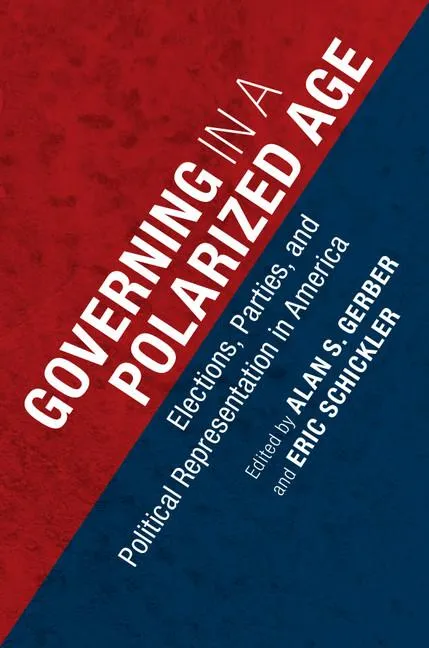
Governing in a Polarized Age
Elections, Parties, and Political Representation in America
Report an issue
Tell us what's wrong and we'll take a look.
Thanks – we got it. We'll review and follow up if needed.
Many political observers have expressed doubts as to whether America's leaders are up to the task of addressing major policy challenges. Yet much of the critical commentary lacks grounding in the systematic analysis of the core institutions of the American political system including elections, representation, and the law-making process. Governing in a Polarized Age brings together more than a dozen leading scholars to provide an in-depth examination of representation and legislative performance. Drawing upon the seminal work of David Mayhew as a point of departure, these essays explore the dynamics of incumbency advantage in today's polarized Congress, asking whether the focus on individual re-election that was the hallmark of Mayhew's ground-breaking book, Congress: The Electoral Connection, remains useful for understanding today's Congress. The essays link the study of elections with close analysis of changes in party organization and with a series of systematic assessments of the quality of legislative performance.
Alan S Gerber
Alan S. Gerber is Divisional Director for the Social Sciences and Dilley Professor of Political Science at Yale University, Connecticut. Co-author of an award-winning textbook on experimental methods, his work has appeared in the leading journals in political science and has received various awards, including the Heinz Eulau Award for the best article in the American Political Science Review. He was elected to the American Academy of Arts and Sciences (2009) and the American Academy of Political and Social Sciences (2013).
Eric Schickler
Eric Schickler is the Jeffrey and Ashley McDermott Professor of Political Science at the University of California, Berkeley. His books include Disjointed Pluralism and Filibuster (both Princeton).


Why Readwise Books?
Readwise Books is an ebook & audiobook platform that automatically logs how much you and your friends read, making it fun and easy to read more. Learn more →