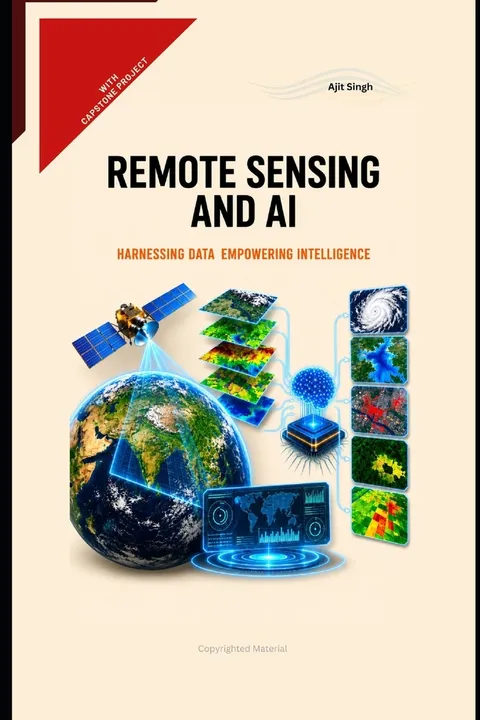
Remote Sensing and AI
Report an issue
Tell us what's wrong and we'll take a look.
Thanks – we got it. We'll review and follow up if needed.
Philosophy
The guiding philosophy of this book is strictly centered on practical implementation and real-world applicability. In the rapidly evolving tech industry, possessing theoretical knowledge of neural networks or satellite wavebands is insufficient; professionals must know how to design, code, deploy, and maintain working systems. Therefore, this book deliberately minimizes abstract, academic theory. Instead, it treats theory strictly as a foundational tool required to achieve successful software implementation.
Key Features
1. End-to-End Coverage: It covers the complete lifecycle of a software product-from data sourcing and framework design to building the AI model, setting up the backend services, and implementing the final cloud deployment.
2. Current and Future Industry Trends: The content is heavily aligned with modern stacks, focusing on Cloud-Native Geospatial architectures, MLOps (Machine Learning Operations), Edge AI, and API integrations.
3. Comprehensive First Chapter: The opening chapter lays a flawless foundation, detailing the exact definitions, history, evolution, version comparisons, components, functions, advantages, and applications of the field, ensuring no prior domain knowledge is required.
4. Live DIY Capstone Project: Chapter 10 is entirely dedicated to a massive, fully functional Capstone Project. It provides the complete, working code for a real-life application, accompanied by step-by-step explanations of the design, functioning, and mode of operations.
5. Scalability and Services: Extensive coverage of deploying models as scalable web services, utilizing components like Docker, cloud infrastructure, and modern deployment frameworks.
Key Takeaways
By the time you finish the final capstone project in Chapter 10, you will possess the following actionable skills:
1. The ability to confidently design, build, and deploy an end-to-end Geospatial AI application from scratch.
2. A deep understanding of how to source, preprocess, and manage massive satellite datasets using modern cloud APIs and data pipelines.
3. The capability to implement machine learning and deep learning algorithms (using simplified, logical steps) specifically tailored for image classification, object detection, and change detection.
4. Expertise in designing software architectures, selecting the correct frameworks, and integrating various components to ensure system scalability.
Disclaimer: Earnest request from the Author.
Kindly go through the table of contents and refer kindle edition for a glance on the related contents.
Thank you for your kind consideration!



Why Readwise Books?
Readwise Books is an ebook & audiobook platform that automatically logs how much you and your friends read, making it fun and easy to read more. Learn more →