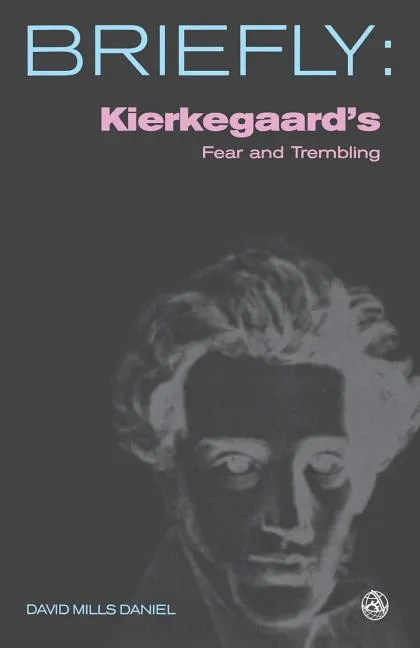
Kierkegaard's Fear and Trembling
Report an issue
Tell us what's wrong and we'll take a look.
Thanks – we got it. We'll review and follow up if needed.
Fear and Trembling is one of Kierkegaard's earliest works, which he wrote under the pseudonym Johannes de Silentio. Kierkegaard had been a student of theology in Copenhagen, and had come to hate the Danish Church. He produced hundreds of leaflets against the Church during his lifetime. However his writing was largely ignored, and he was not a popular or well-regarded thinker in his own time. Hegel's writing largely dominated philosophical thought throughout Kierkegaard's life. Hegel believed that the highest goal for a person should be to loose oneself in the Universal. One should put aside his personal goals and ambitions and be motivated exclusively by the general interests of all. Kierkegaard regarded the individual above all else and so was repelled by Hegel's communitarian ethic. His Fear and Trembling is a sustained response to Hegel's ideas. It uses the story of Genesis 22, 1-18, where Abraham was willing to sacrifice Isaac without question, and only faith, to put across his own ideas and philosophy. Fear and Trembling is a required text on the UK A level syllabus.
David Mills Daniel
David R Law is Reader in Christian Thought in the School of Arts, Histories and Cultures, at the University of Manchester, UK.
More by David Mills Daniel


Why Readwise Books?
Readwise Books is an ebook & audiobook platform that automatically logs how much you and your friends read, making it fun and easy to read more. Learn more →