Report an issue
Tell us what's wrong and we'll take a look.
Thanks – we got it. We'll review and follow up if needed.
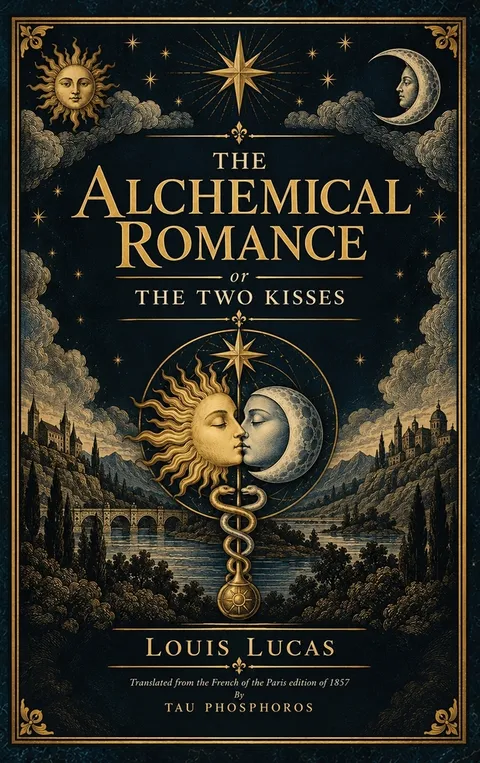
In 1887 Papus set out the figures who mattered to the occultism of his moment - Hoëné-Wroński, Éliphas Lévi, Saint-Yves d'Alveydre, Madame Blavatsky - and put Louis Lucas at the head of the list, calling this book a merveilleuse analyse occulte, sociale et philosophique sous forme de roman. He had hunted two years for a copy of Lucas's chemistry. The novel he praised has never been published in English. This is its first English edition.
Le Roman alchimique, ou Les Deux Baisers appeared in Paris from Michel Lévy Frères in 1857, the year Flaubert stood trial for Madame Bovary and Baudelaire for Les Fleurs du mal. It has ten chapters, and two of them carry two-thirds of the volume: a hundred and forty-two pages of doctrine delivered across a dinner table by a former minister of Louis-Philippe, and ninety-nine more delivered by a masked woman at the Opera ball at three in the morning, to a man chiefly occupied with working out whether she is pretty.
What makes the book singular is stated by Papus in a sentence: Lucas employs no symbolic term. There is no green lion here, no prima materia, no sealed vessel. There is optics, acoustics, electrochemistry and comparative anatomy, conducted in the working vocabulary of 1850 and pressed toward conclusions that vocabulary was not built to carry. A universal force he calls movement; its laws studied as the laws of the series, of which the trinitary series is the base; the soul and matter as one form at two scales; divinization as a condensation, the soul gathering a power that is everywhere available as a body gathers a charge. He denies that Pythagoras and Plato were ever seriously initiated, relocates initiation to the observatory, and expects the arcanum to be dissolved by instruments rather than guarded by initiates.
Around that doctrine runs a love story that turns out to be the same argument in another language. Two sisters divided by temperament and by confession; a narrator who finds himself a man in the presence of one and a woman in the presence of the other; and two kisses, eighty-seven pages apart, the first accidental and the second demanded indoors under conditions the man specifies, because a kiss in this book is a transmission that carries the individual across.
Almost nothing is documented of the man. He edited a Bonapartist daily through the last years of the Second Republic, dedicated this book to the memory of Pellegrino Rossi - the minister assassinated on the steps of the Cancelleria in 1848, and the master who had turned him away from the sciences - and died in 1863 with his work unread.
This edition establishes that the doctrine was written in 1850-51 and therefore precedes Lucas's own La Chimie nouvelle of 1854 - which reverses the usual account of the novel as a popularization of the treatise. The evidence is set out in the introduction, along with what can and cannot be known of a man who died unread, "plundered by theorists of every school, mentioned by no dictionary."
The translation is made from the Michel Lévy text, corrected page by page against the page images, and holds Lucas's technical vocabulary fixed throughout. It carries an introduction in eight sections, a note on the text, a glossary of the controlled vocabulary, and 669 notes, including Lucas's own six.


Why Readwise Books?
Readwise Books is an ebook & audiobook platform that automatically logs how much you and your friends read, making it fun and easy to read more. Learn more →