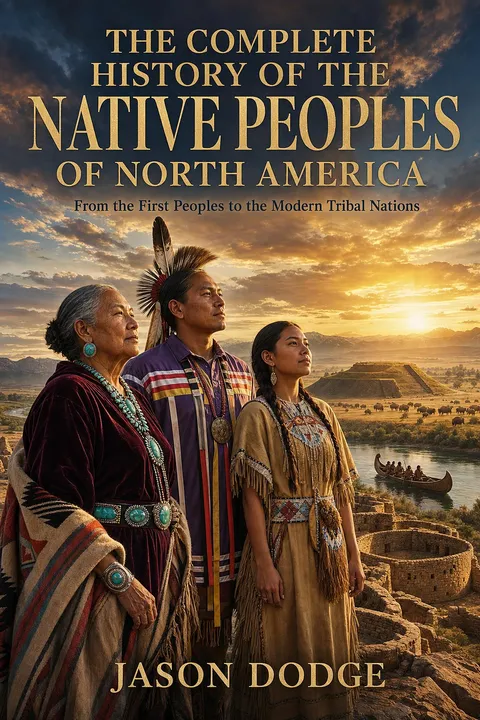
The Complete History of the Native Peoples of North America
Report an issue
Tell us what's wrong and we'll take a look.
Thanks – we got it. We'll review and follow up if needed.
There was never one Native America. There were, and are, hundreds of nations, each with its own language, government, homeland and history. This illustrated volume tells their story from the first peoples to the 575 federally recognized tribal nations of today.
The book begins with the mound builders of Poverty Point, Adena, Hopewell and Cahokia and the great houses of Chaco Canyon and Mesa Verde. It then travels through the homelands of the Arctic, Northwest Coast, California, the Plains, the Southwest, the Great Lakes, the Eastern Woodlands and the Southeast. You will meet the Haudenosaunee and their Great Law of Peace, the Cherokee and Sequoyah's syllabary, the Comanche and the horse, the Powhatan, Wampanoag, Lakota, Nez Perce, Apache, Diné, Unangax, Alaska Native peoples and Native Hawaiians.
This is also a book about how people lived. Separate chapters explain how longhouses, plank houses, earth lodges, tipis, hogans and adobe pueblos were built, what people ate and wore, how canoes and trails linked a continent, how law and education worked, how records were kept without paper, how the dead were buried and remembered, and how lacrosse and other games shaped community life.
The narrative follows contact, disease, trade, King Philip's War, the Revolution, the Marshall court decisions, removal and the Trail of Tears, the Seminole Wars, Sand Creek, Little Bighorn, the Nez Perce flight, the Apache wars, Wounded Knee, the Dawes Act and the boarding schools. It continues through citizenship, the Indian New Deal, the code talkers, termination, Red Power and self-determination to the courts, governments and land struggles of the present.
Every chapter ends with The Historian's Verdict, a clear look at what the evidence proves, what it suggests and what remains unknown. Three cultural interludes, a compendium of leaders, a timeline, battles, treaties and court cases, nations and sites to visit, a cast of characters, a glossary and a guide to further reading complete the volume.
Native nations are not a vanished people. This history is told in the past tense where it belongs and in the present tense where the nations and their traditions endure.






Why Readwise Books?
Readwise Books is an ebook & audiobook platform that automatically logs how much you and your friends read, making it fun and easy to read more. Learn more →