Report an issue
Tell us what's wrong and we'll take a look.
Thanks – we got it. We'll review and follow up if needed.
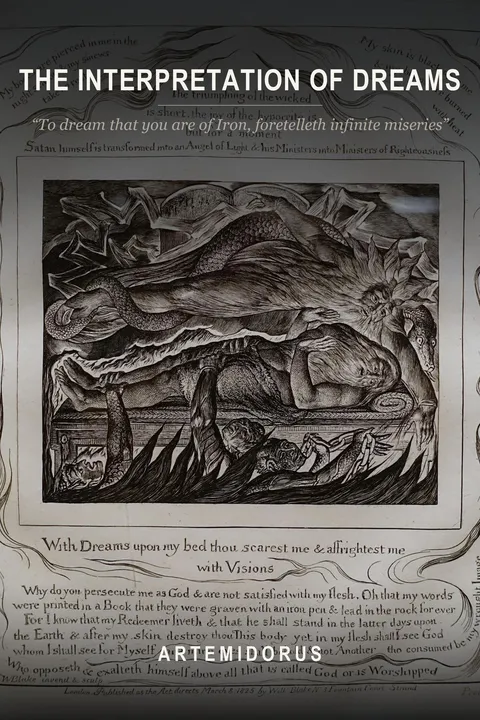
Artemidorus of Daldis wrote the Oneirocritica in the second century AD. He was not a philosopher arguing a theory but a working interpreter who treated the subject as a craft to be learned from evidence, and he says in his preface that he assembled the book by travelling, buying up whatever had been written on dreams, and spending years in the company of the diviners other educated men refused to sit with.
What he produced is the founding text of the whole tradition. Five books, arranged by subject, moving from birth and the parts of the body through food, work, weather, animals, the gods and death. Every dream dictionary published since is descended from it, usually without saying so.
Two things make it stranger and better than its descendants. The first is that Artemidorus does not believe a dream has one meaning. He insists that the reading depends on the dreamer, and returns to the point relentlessly: the same dream is fortunate for a merchant and disastrous for a soldier, good for the sick and meaningless for the healthy. The second is that he is arguing throughout with interpreters he thinks are careless, which makes the book a record of a live professional dispute rather than a list of correspondences.
Robert Wood's translation of 1644 is the earliest complete English version and the one that carried Artemidorus into the language. It has never been widely available in a readable modern setting.
This edition sets Wood's English rather than a paraphrase of it. The 1644 orthography has been modernised, with roughly eight and a half thousand changes recorded by class: the long s normalised, the compositor's end-of-line hyphens removed, and period spellings brought forward where the modern form is certain. Where it is not certain, the printed form is kept, and the edition says how many such words were left.
The surviving copy the transcription was taken from has letters and words the scanner could not read. The Editors have supplied them from the sense of the passage in all but two places, which are left marked, and every supplied reading is listed, with the Editors' confidence in it, in the publisher's record. No text is missing: four places once taken for lost pages are duplicate images in the scan.
A new index of dream subjects, built from the book's own section headings, runs to more than two hundred entries. The 1644 edition has none.
Robert Wood
Translated by
Robert E. Wood is Professor of Philosophy in the Institute of Philosophic Studies at the University of Dallas. He has written ninety articles and eight books, his most recent being The Beautiful, the True, and the Good: Studies in the History of Thought, a collection of papers from 1966 to 2012. He is a past president of the American Catholic Philosophical Association and for twenty years was the editor of American Catholic Philosophical Quarterly.


Why Readwise Books?
Readwise Books is an ebook & audiobook platform that automatically logs how much you and your friends read, making it fun and easy to read more. Learn more →