Report an issue
Tell us what's wrong and we'll take a look.
Thanks – we got it. We'll review and follow up if needed.
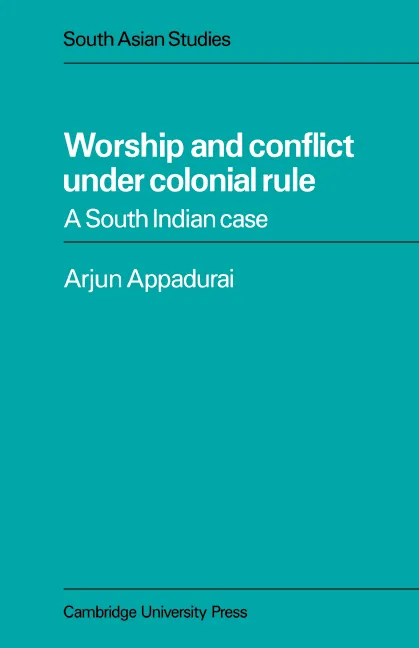
Although temples have been important in South Indian society and history, there have been few attempts to study them within an integrated anthropological framework. Professor Appadurai develops such a framework in this ethnohistorical case study, in which he interprets the politics of worship in the Sri Partasarati Svami Temple, a famous ancient Sri Vaisnava shrine in India. The author uses the methods and concepts of both cultural anthropology and social history to construct a model of institutional change in South Asia under colonial rule. Focusing on the problem of authority as a cultural concept and as a managerial reality, Professor Appadurai considers some classic problems of South Asian anthropology: problems of deference, sumptuary symbolism, and religious organization. In addition, he addresses such issues as the nature of conflict under a hybrid colonial legal system, the political implications of sumptuary disputes, and the structure of relations between polity and religion in pre-modern South Asia. These aspects of the study should interest a broad range of scholars.
Arjun Appadurai
Arjun Appadurai is Goddard Professor of Media, Culture and Communication at New York University. He is the author of many books and articles, including Modernity at Large: Cultural Dimensions of Globalization; The Social Life of Things: Commodities in Cultural Perspective; and Fear of Small Numbers: An Essay on the Geography of Anger.
More by Arjun Appadurai








Why Readwise Books?
Readwise Books is an ebook & audiobook platform that automatically logs how much you and your friends read, making it fun and easy to read more. Learn more →