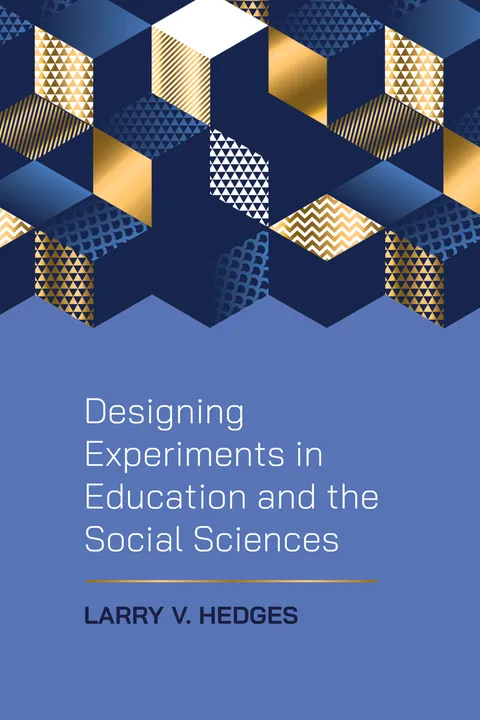
Designing Experiments in Education and the Social Sciences
Report an issue
Tell us what's wrong and we'll take a look.
Thanks – we got it. We'll review and follow up if needed.
Randomized experiments--often referred to as the gold standard of research design--are generally accepted as the type of studies that provide the strongest evidence about cause and effect. There has been a wide adoption of experimental methods in agriculture, medicine, industrial design, and laboratory social sciences, such as experimental psychology, where conditions can be controlled. Since then, there has been an increase in the use of field experiments to provide evidence of cause and effect beyond the laboratory. However, the social settings in which these studies take place complicate the design and evaluation of experiments because their social contexts must be taken into account in order for the experiment to provide useful and unambiguous results. In Designing Experiments in Education and the Social Sciences, statistician Larry V. Hedges details how to design educational and social science field experiments that are sensitive enough to provide clear-cut evidence on the effects of social interventions.
Hedges draws on one hundred years of statistical theory and classic experimental design in Designing Experiments in Education and the Social Sciences. Highlighting the social-structural information embedded in field experiments, he links this history with contemporary statistical methods in the social sciences to explain how to design social experiments that are adequately sensitive to determine the influence of an intervention. He covers the four basic research designs--and 39 elaborations of those designs--that are used most often in social experiments while also introducing additional, more complex, designs. He brings together, in the same notation, work on experimental design, design sensitivity, and optimal design of experiments for the most frequently used research designs in education and the social sciences, emphasizing their conceptual consistency. Hedges also discusses the practical problems of how to recruit and maintain a sample throughout the duration of an experiment.
Designing Experiments in Education and the Social Sciences is an essential resource for researchers planning educational and social field experiments and graduate students.
Larry V Hedges
Larry V. Hedges is one of eight Board of Trustees Professors at Northwestern, the university’s most distinguished academic position. He holds appointments in statistics and data science, psychology, education and social policy, and medical social sciences. Previously, he was the Stella M. Rowley Distinguished Service Professor at the University of Chicago. He received the Yidan Prize in Education Research in 2018 and the José Vasconcelos World Award of Education from the World Culture Council in 2023 He is an elected member of the National Academy of Education and is a fellow of the American Academy of Arts and Sciences, the American Statistical Association, the American Psychological Association, the Association for Psychological Science, and the American Educational Research Association. He is also a member of the Society for Research on Educational Effectiveness, which established an annual endowed lecture in his honor. He was selected to give the inaugural Hedges Lecture in 2016. Hedges was nominated by President Barack Obama to the Board of Directors of the National Board for Education Sciences, was confirmed by the U.S. Senate in June 2012, and was elected Chair of the Board in 2016. Widely published, he has authored or co-authored 250 journal articles and 13 books including Coe, Waring, Hedges, & Day Ashley, Research Methods and Methodologies in Education, 3rd edition (2021, Sage London). He has also co-directed research training institutes on research design funded by the US Institute of Education Sciences, the National Institutes of Health, and the National Science Foundation for the last 20 years.
More by Larry V Hedges



Why Readwise Books?
Readwise Books is an ebook & audiobook platform that automatically logs how much you and your friends read, making it fun and easy to read more. Learn more →