Report an issue
Tell us what's wrong and we'll take a look.
Thanks – we got it. We'll review and follow up if needed.
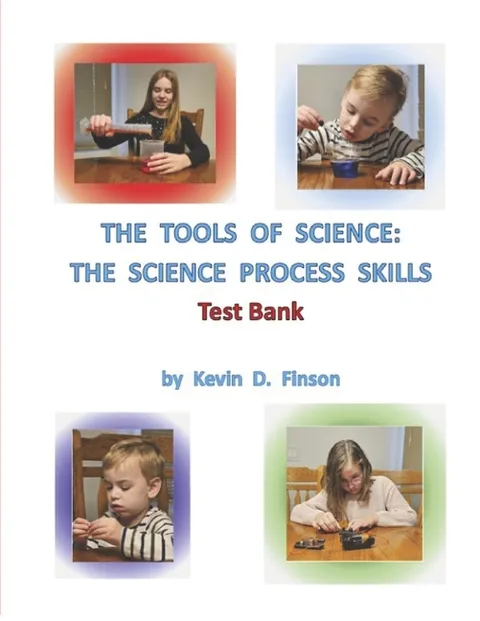
THE TOOLS OF SCIENCE: THE SCIENCE PROCESS SKILLS!
A GREAT SUPPORTING RESOURCE FOR THE TOOLS OF SCIENCE!
This book contains tests that help the teacher assess the level to which students have learned about and applied the tools scientists use when doing their investigating and research. Those tools are called the science process skills. They are the foundation upon which good quality science learning is built. It is important students know the science process skills so they can effectively engage in the scientific enterprise.
The book is an important companion to the Student Manual and Teacher Manual. Its 148 pages begin with some explanation about the role of testing and assessing student learning and provides some suggestions for hands-on "lab practical" types of assessment to augment the objective-based (knowledge-based) assessment that makes up each of the chapter tests in the book.
The questions in each of the chapter tests are derived from the experiences students should have from doing the hands-on/minds-on activities in the Student Manual as well as from information contained in the Teacher Manual which the teacher should have taught with each lesson/activity.
Each test bank chapter includes the student version of the chapter test followed by the key, or teacher version, of the test to assist teachers in quickly determining the level of success of students in their learning the science process skills.
Kevin D Finson
Dr. Finson is a professor of science education at Bradley University in Peoria, IL, where he teaches elementary and secondary science education courses. His teaching has included middle school and high school life, physical, and earth sciences, college-level earth science content courses, a foundations course in strategies and techniques, and graduate courses in instructional theory and program evaluation.
He has served as a member of the board of directors for the international Association for Science Teacher Education (ASTE), and chaired its Professional Development Committee and Inclusive Science Education Forum. He has also contributed to the standards for the Early Adolescent Science Committee of the National Board of Professional Teaching Standards. Dr. Finson has also edited the international Journal of Elementary Science Education, served on editorial boards of several national science education journals, and has served on the publications committees of two national professional organizations. Dr. Finson has maintained a consistent record of publication in national refereed and practitioner journals.
Dr. Finson has two primary areas of research interest. The first focuses on making science more accessible to students who have special learning needs. In particular, he explores how teachers can make adjustments and modifications to written materials, procedures, and simple equipment so students who have specific learning disabilities can successfully engage in doing science. The area focuses on students' perceptions of scientists, which has included development of a framework to guide science educators in dealing with students' conceptions of scientists.
More by Kevin D Finson



Why Readwise Books?
Readwise Books is an ebook & audiobook platform that automatically logs how much you and your friends read, making it fun and easy to read more. Learn more →