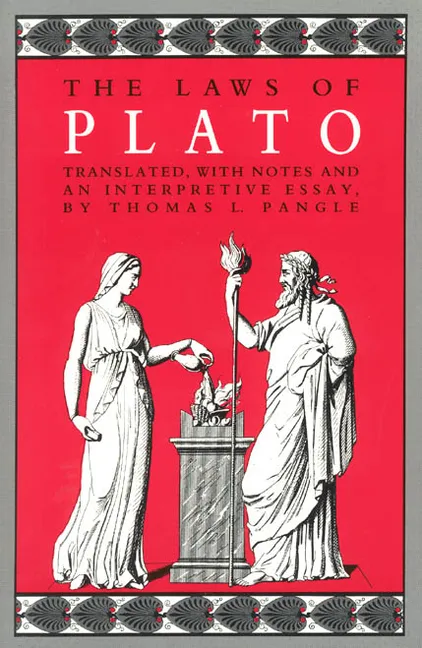
The Laws of Plato
Report an issue
Tell us what's wrong and we'll take a look.
Thanks – we got it. We'll review and follow up if needed.
"Because it succeeds in being both literal and comprehensive, it is by far superior to any translation available. By reproducing dramatic detail often omitted, such as oaths, hesitations, repetitions, and forms of address, Pangle allows the reader to follow the dialogue's interplay between argument and dramatic context. . . . Pangle's translation captures the excitement and the drama of Plato's text."--Mary P. Nichols, Ancient Philosophy
"Pangle's achievement is remarkable. . . . The accompanying interpretive essay is an excellent distillation of a dialogue three times its size. The commentary is thoughtful, even profound; and it amply demonstrates the importance of reading Plato carefully and from a translation that is true to his language."--Patrick Coby, American Political Science Review
Plato
Plato (c. 427-347 BC) was a classical Greek philosopher, mathematician, writer, and student of Socrates. Most of his works, which form some of the core foundations of Western philosophy, are written in the form of dialogues, in which Socrates often figures prominently. His best-known writings include the Republic, the Apology, the Symposium, Crito, and Statesman. Plato's work addresses such diverse themes as the nature of love, human knowledge and understanding, and the ideal form of government.
More by Plato





Why Readwise Books?
Readwise Books is an ebook & audiobook platform that automatically logs how much you and your friends read, making it fun and easy to read more. Learn more →