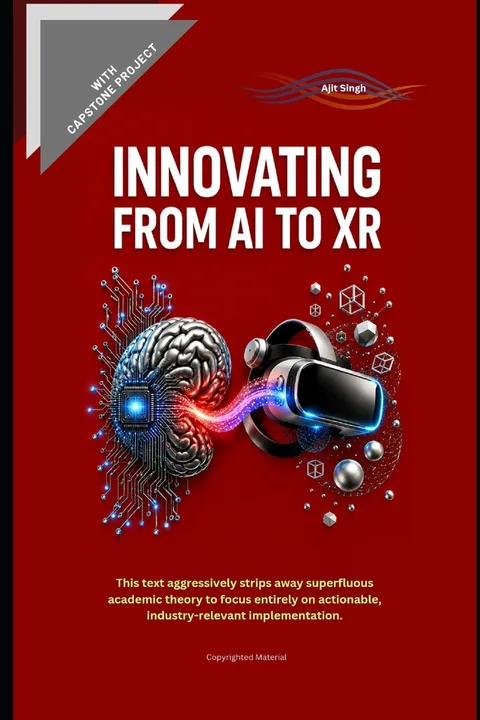
Innovating from AI to XR
Report an issue
Tell us what's wrong and we'll take a look.
Thanks – we got it. We'll review and follow up if needed.
I worked on the principle that complex technologies like Artificial Intelligence and Extended Reality are not magic; they are systems composed of logical, sequential steps. By demystifying the "black box" of AI models and the intricate rendering pipelines of XR, this text proves that anyone can build advanced spatial computing applications if provided with the correct blueprint. The philosophy emphasizes a "scratch-to-production" mindset. We will not start with pre-built, hidden templates that obscure the underlying mechanics. Instead, we will configure the environment, design the architecture, write the core logic, integrate the services, and push the final build to a device. This ensures the reader understands the entire lifecycle of an application, a critical requirement for real-world industry roles.
Key Features
1. Complete Lifecycle Coverage: Guides the reader through design, modeling, architecture planning, framework selection, component integration, implementation, deployment, and final production.
2. Simple Algorithm Formatting: All programmatic logic and algorithms are presented as easy-to-read, step-by-step lists, assuming no prior advanced mathematical background.
3. End-to-End Capstone Project: The final chapter is a massive, completely functional DIY project containing complete working code, bringing together every concept from the previous nine chapters into a single, deployable XR/AI application.
4. Industry-Relevant Stack: Focuses on the exact tools, APIs, and frameworks currently demanded by top tech companies, ensuring the skills acquired are highly employable.
5. Comprehensive Chapter 1: Provides an exhaustive foundational understanding of the AI to XR pipeline, comparing historical data, evolution, versions, advantages, and disadvantages to set a rock-solid baseline.
Key Takeaways
By the time you complete this text and the final capstone project, you will possess the practical ability to:
1. Understand and articulate the complete architecture, components, and functioning of converged AI and XR systems.
2. Set up a professional development environment from scratch, configuring all necessary SDKs, APIs, and cross-platform frameworks.
3. Design and build simple, effective AI models (such as computer vision and NLP) tailored specifically for spatial computing environments.
4. Integrate Python-based AI microservices with C#/C++ based real-time 3D rendering engines.
5. Deploy fully functional Mixed Reality applications to physical standalone headsets or mobile devices.
6. Implement enterprise-grade cloud services to handle heavy computational AI tasks, keeping the XR client lightweight and performant.
7. Navigate the entire product lifecycle from initial design, through coding and implementation, to final production and optimization for real-world industry use cases.
Disclaimer: Earnest request from the Author.
Kindly go through the table of contents and refer kindle edition for a glance on the related contents.
Thank you for your kind consideration!



Why Readwise Books?
Readwise Books is an ebook & audiobook platform that automatically logs how much you and your friends read, making it fun and easy to read more. Learn more →