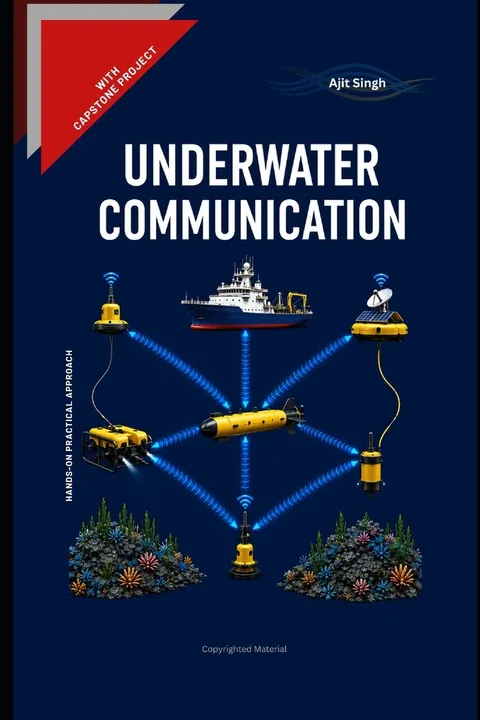
Underwater Communication
Report an issue
Tell us what's wrong and we'll take a look.
Thanks – we got it. We'll review and follow up if needed.
Philosophy
The core philosophy of this book is "learning through direct implementation." My philosophy is rooted in pragmatism. I believe that the best way to understand an underwater network is to physically code its protocols, configure its hardware, and deploy it. I focused heavily on how to develop solutions and apps. Instead of dedicating pages to the derivation of wave equations, I dedicated those pages to writing serial interfaces in Python, configuring MAC protocols, and handling data packet loss in real-time. Everything is tailored to the trends and requirements of the real-life industry, ensuring that the skills acquired here are immediately translatable to professional engineering roles.
Key Features
1. Industry-Relevant Focus: Aligned entirely with modern industrial demands, including AUV telemetry, offshore sensor networks, and ROV video streaming.
2. Comprehensive Lifecycle Coverage: Detailed instructions covering the design, model, architecture, framework, services, components, functioning, and mode of operations.
3. Hardware and Software Integration: Practical guides on connecting microcontrollers (like Raspberry Pi or Arduino) to commercial underwater modems via standard protocols (RS232, Ethernet).
4. Real-Life Case Studies: Examples from actual oil and gas, defense, and environmental deployments to illustrate how concepts are utilized in the field.
5. Working Capstone Project: A complete, live DIY project in the final chapter, featuring full source code and line-by-line explanations for building an underwater telemetry dashboard.
6. Deployment and Testing Strategies: Extensive coverage on how to waterproof electronics, manage battery life, and conduct pool and open-water tests.
Key Takeaways
By completing this book, readers will extract highly valuable, actionable skills:
1. System Design: The ability to architect an underwater communication network from scratch, selecting the correct physical layer (Acoustic, Optical, or RF) based on environmental constraints.
2. Protocol Implementation: Practical knowledge of how to write and deploy Medium Access Control (MAC) and routing protocols tailored for high-delay, low-bandwidth environments.
3. App Development: The capacity to develop robust software applications that can parse, decode, and visualize underwater telemetry data in real-time.
4. Hardware Mastery: The competence to select, configure, and interface with commercial marine modems, sensors, and transducers.
5. Production Readiness: A thorough understanding of how to transition a prototype from a laboratory simulator into a fully waterproofed, power-optimized, ocean-ready production unit.
Disclaimer: Earnest request from the Author.
Kindly go through the table of contents and refer kindle edition for a glance on the related contents.
Thank you for your kind consideration!



Why Readwise Books?
Readwise Books is an ebook & audiobook platform that automatically logs how much you and your friends read, making it fun and easy to read more. Learn more →