Report an issue
Tell us what's wrong and we'll take a look.
Thanks – we got it. We'll review and follow up if needed.
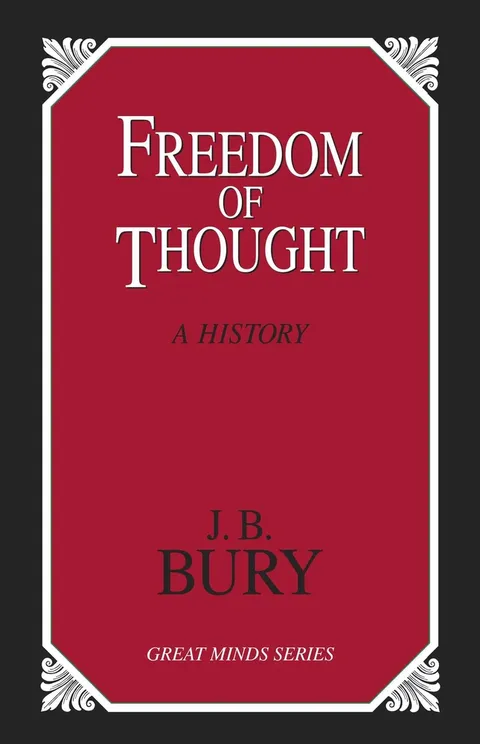
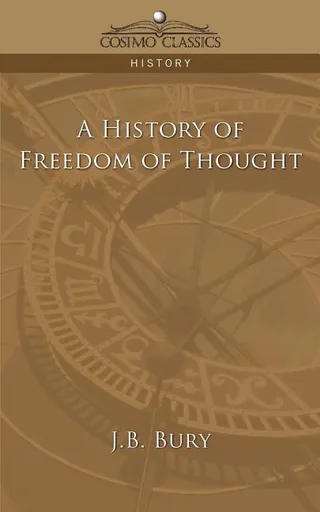
Most people who live in open societies, especially in the West, take freedom of thought and the right to express that thought for granted. But through most of history, independent thinking, outside of the framework of social or religious convention, was discouraged and often actively persecuted. It is only recently that rational critiques of traditional perspectives have become an accepted part of public discourse. The struggle for independence of mind was many centuries in the making and involved repression, bloodshed, and martyrdom as well as breakthrough discoveries and heroic individuals who changed the way we look at the world, many times at risk to their own lives. One of the best surveys of this dramatic intellectual history is J. B. Bury's Freedom of Thought. With striking eloquence and clarity of expression, Bury succinctly describes the struggle of reason in the search for truth from ancient times to the beginning of the 20th century. He leads the reader from the amazing florescence of rational inquiry in classical Greece, through the eclipse of free thought under the sway of religious authority during much of the Middle Ages, to the rediscovery of Greco-Roman philosophy in the Renaissance, and finally to the growth of rationalism during the Enlightenment and the scientific revolution. Along the way, Bury elucidates the key events that contributed to the modern rational comprehension of nature. He also provides thumbnail sketches of the many important persons - philosophers, scientists, and writers - who championed independent thinking and laid the groundwork for contemporary Western culture.Though written more than ninety years ago, this erudite yet very accessible intellectual history should be on the bookshelves of everyone who values reason and independent thinking.
J B Bury
John Bagnell Bury, FBA, was an Anglo-Irish historian, classical scholar, medieval Roman historian, and philologist. He clearly rejected the title "Byzantinist" in the preface to the 1889 edition of his Later Roman Empire. He was Erasmus Smith's Professor of Modern History at Trinity College Dublin from 1893 to 1902, then Regius Professor of Modern History at the University of Cambridge and a Professorial Fellow of King's College, Cambridge from 1902 until his death. Bury was born in Clontibret, County Monaghan, in 1861 as the son of Edward John Bury and Anna Rogers. His father was the Rector of the Anglican Church of Ireland. He was first educated by his parents before attending Foyle College in Derry. He was 24 years old when he was elected a fellow of Trinity College Dublin in 1885. That same year, he married his second cousin Jane Bury, who helped him with his work, particularly her chapter on Byzantine art in the History of the Later Roman Empire (1889); they had one son. In 1893, he was appointed to Trinity College's Erasmus Smith's Chair of Modern History, where he served for nine years. In 1898, he was named Regius Professor of Greek at Trinity, a position he maintained alongside his history professorship.[4] In late 1902, he became Regius Professor of Modern History at the University of Cambridge.
More by J B Bury


Why Readwise Books?
Readwise Books is an ebook & audiobook platform that automatically logs how much you and your friends read, making it fun and easy to read more. Learn more →