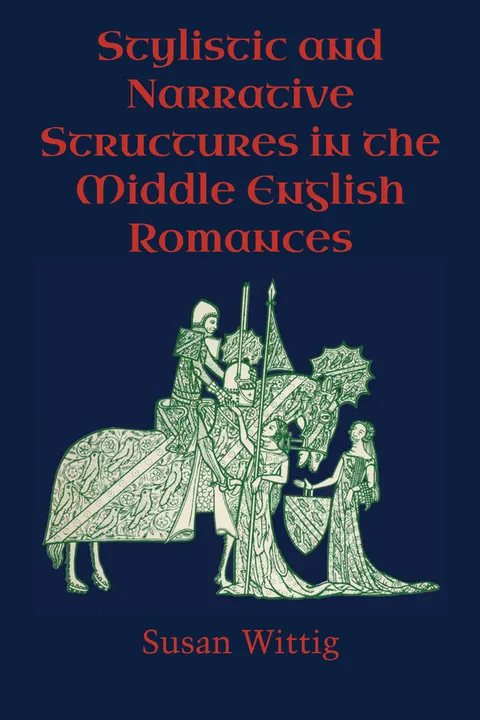
Stylistic and Narrative Structures in the Middle English Romances
Report an issue
Tell us what's wrong and we'll take a look.
Thanks – we got it. We'll review and follow up if needed.
This volume provides a generic description, based on a formal analysis of narrative structures, of the Middle English noncyclic verse romances. As a group, these poems have long resisted generic definition and are traditionally considered to be a conglomerate of unrelated tales held together in a historical matrix of similar themes and characters. As single narratives, they are thought of as random collections of events loosely structured in chronological succession. Susan Wittig, however, offers evidence that the romances are carefully ordered (although not always consciously so) according to a series of formulaic patterns and that their structures serve as vehicles for certain essential cultural patterns and are important to the preservation of some community-held beliefs.
The analysis begins on a stylistic level, and the same theoretical principles applied to the linguistic formulas of the poems also serve as a model for the study of narrative structures. The author finds that there are laws that govern the creation, selection, and arrangement of narrative materials in the romance genre and that act to restrict innovation and control the narrative form.
The reasons for this strict control are to be found in the functional relationship of the genre to the culture that produced it. The deep structure of the romance is viewed as a problem-solving pattern that enables the community to mediate important contradictions within its social, economic, and mythic structures. Wittig speculates that these contradictions may lie in the social structures of kinship and marriage and that they have been restructured in the narratives in a "practical" myth: the concept of power gained through the marriage alliance, and the reconciliation of the contradictory notions of marriage for power's sake and marriage for love's sake.
This advanced, thorough, and completely original study will be valuable to medieval specialists, classicists, linguists, folklorists, and Biblical scholars working in oral-formulaic narrative structure.
Susan Wittig
Susan Wittig Albert is the award-winning, New York Times bestselling author of Loving Eleanor (2016), about the intimate friendship of Eleanor Roosevelt and Lorena Hickok; and A Wilder Rose (2014), about Rose Wilder Lane and the writing of the Little House books. Her award-winning fiction also includes mysteries in the China Bayles series, the Darling Dahlias, the Cottage Tales of Beatrix Potter, and a series of Victorian-Edwardian mysteries she has written with her husband, Bill Albert, under the pseudonym of Robin Paige. She has written two memoirs: An Extraordinary Year of Ordinary Days and Together, Alone: A Memoir of Marriage and Place, published by the University of Texas Press. Susan Albert is founder of the Story Circle Network, an international not-for-profit membership organization made up of thousands of women who want to document their lives and explore their personal stories through journaling, memoir, autobiography, personal essays, poetry, fiction, nonfiction, drama, and mixed-media, based in Austin, Texas. Susan Wittig Albert is a member of the Texas Institute of Letters and lives in the rugged Texas Hill Country, in the small town of Bertram, just northwest of Austin.
More by Susan Wittig


Why Readwise Books?
Readwise Books is an ebook & audiobook platform that automatically logs how much you and your friends read, making it fun and easy to read more. Learn more →