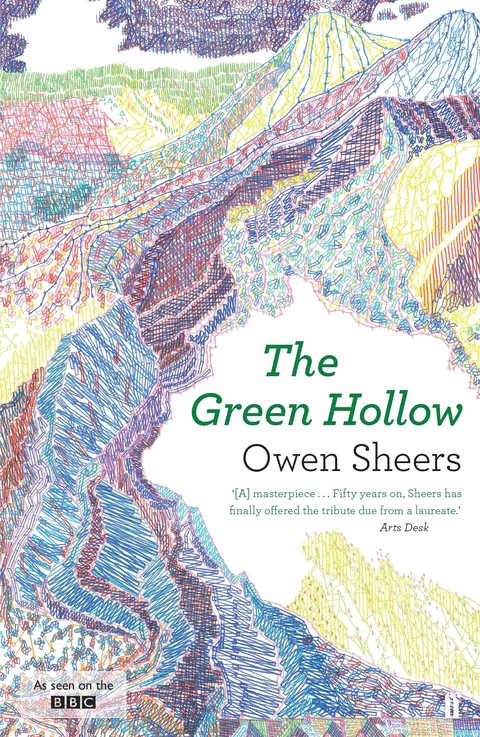
The Green Hollow
Report an issue
Tell us what's wrong and we'll take a look.
Thanks – we got it. We'll review and follow up if needed.
In 1966 a coal slag heap collapsed on a school in south Wales, killing 144 people, most of them children. Poet Owen Sheers has given voice to those who still live in Aberfan, the pit village in which tragedy struck, and using their collective memories has created a striking work of poetic power.
Sheers set out to paint a portrait not just of what happened, but also of what was lost. What was Aberfan like in 1966? What were the interests of the people, the social life, the sporting obsessions, the bands of the day? What was the deeper history of the place? Why had it become the mining village it was, and what had it been before the discovery of coal under its soil? Perhaps most significantly, what was Aberfan like today?
The Green Hollow is a historical story with a deeply urgent contemporary resonance: a story of what can happen when a community is run by a corporation. It is also a story known along generational rather than geographic borders. Based on the BBC One production, The Green Hollow is a beautifully rendered picture of a time and place - and a life-altering event whose effects are felt to this day.
Owen Sheers
Owen Sheers was born in Fiji in 1974 and brought up in Abergavenny, South Wales.
The winner of an Eric Gregory Award and the 1999 Vogue Young Writer's Award, his first collection of poetry, The Blue Book (Seren, 2000) was short-listed for the Welsh Book of the Year and the Forward Prize Best First Collection 2001. His debut prose work The Dust Diaries (Faber, 2004), a non-fiction narrative set in Zimbabwe, was shortlisted for the Royal Society of Literature's Ondaatje Prize and won the Welsh Book of the Year 2005. In 2004 he was Writer in Residence at the Wordsworth Trust and was selected as one of the Poetry Book Society's 'Twenty Next Generation Poets'. Owen's second collection of poetry, Skirrid Hill (Seren, 2005) won a 2006 Somerset Maugham Award and is a WJEC and AQA A level set text. Unicorns, almost his one man play based on the life and poetry of the WWII poet Keith Douglas was developed by Old Vic, New Voices.
Owen's first novel, Resistance, has been translated into eight languages. His recent collaboration with composer Rachel Portman, The Water Diviner's Tale, an oratorio for children, was premiered at the Royal Albert Hall for the BBC Proms 2007. His essay Bomb Gone, about Britain's Christmas Island thermonuclear tests, appears in Granta 101. Owen is currently a Dorothy and Lewis B. Cullman Fellow at the New York Public Library.
More by Owen Sheers


Why Readwise Books?
Readwise Books is an ebook & audiobook platform that automatically logs how much you and your friends read, making it fun and easy to read more. Learn more →