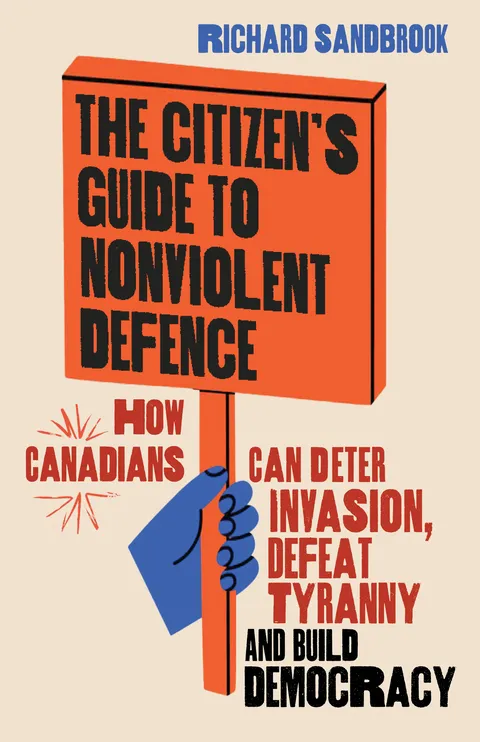
The Citizen’s Guide to Nonviolent Defence
How Canadians Can Deter Invasion, Defeat Tyranny and Build Democracy
Report an issue
Tell us what's wrong and we'll take a look.
Thanks – we got it. We'll review and follow up if needed.
For Canada and other middle and smaller powers facing predatory super-powers, nonviolent defence (NVD) is a strategic concept whose time has arrived.
The stench of imperial conquest is again in the air. How do middle and smaller powers defend themselves when the potential aggressor is a nearby superpower? That is Canada’s conundrum today, one that European countries fearful of Russia’s ambitions and Asian countries confronting China’s aggressive actions equally share. A solely military response to superpower aggression, assuming no rescue by a powerful ally, would not only fail, but also be devastating in casualties and destruction. There is, however, an alternative: nonviolent civilian defence.
Nonviolent defence utilizes a panoply of nonviolent tactics to deter an invasion and, if one occurs, to defeat it. The three stages of resistance—symbolic protests, noncooperation and disruption—flow sequentially, though severe repression may compel a return to an earlier stage. The aim is to deny the opponent control over seized territory and to undermine its support base: by weakening the morale of the invading force, by fomenting mass protests in the invader’s home country and by inducing international condemnation of the “pariah state.” Although improvised nonviolent defence has proved a potent response historically, this strategy is most effective when resistors organize in advance.
Historical cases of improvised nonviolent resistance and scholarly analysis suggest that this approach can work effectively and at significantly lower cost than military warfare. The key to success is prior organization, planning and training of volunteers. However, major obstacles impede an objective appraisal of strategic nonviolent resistance. Impediments include the far-reaching influence of the Military-Industrial-Intellectual Complex, the popular culture of violence and martial valour and the ingrained association of defence with military defence in the popular imagination.
Nonviolent defence works only if people think there is something of value to defend. With this impetus, it can function as one facet of a much-needed rejuvenation of democracy.
Richard Sandbrook
Richard Sandbrook is Professor of Political Science at the Munk Centre for International Studies at the University of Toronto. He is the author of many books, including most recently, Closing the Circle: Democratization and Development in Africa.
More by Richard Sandbrook


Why Readwise Books?
Readwise Books is an ebook & audiobook platform that automatically logs how much you and your friends read, making it fun and easy to read more. Learn more →