Report an issue
Tell us what's wrong and we'll take a look.
Thanks – we got it. We'll review and follow up if needed.
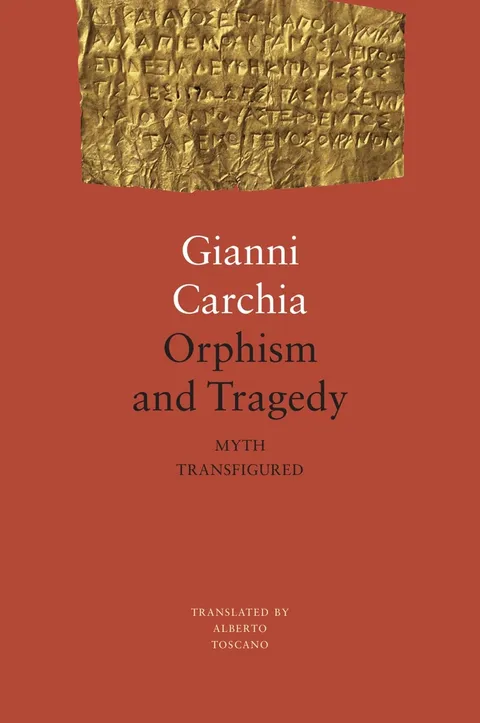
A reimagining of the ancient Greek mystical movement Orphism.
What does it mean to step outside the civic order through poetry? Ever since it first emerged in Greece around the sixth century BC, Orphic doctrine has marked a powerful rupture with the ancient world. Its salvific practices, closely tied to a belief in the soul's immortality, its resolute rejection of sacrificial ritual and embrace of vegetarianism, and its distinctive conception of time and memory all defined a way of life, the bios orphikos, that was at once poetic and political.
In this brief yet densely layered text, Gianni Carchia returns to Orphism in all its implications. It becomes clear that, for Carchia, Orphism is not merely a historiographical concern, but an aesthetic and political one. If tragedy constitutes one of the central pillars around which the polis was formed, Orphism represents a radically different path--an alternative to the polis itself--by placing the poetic word, in all its autonomous power, at its core. And if the relationship between philosophy and tragedy has long been a central theme in the history of Western thought, Carchia's reflections here ask a different question: Is the Orphic path still accessible to us today?
Gianni Carchia
Gianni Carchia (1947-2000) was one of the most important and original Italian philosophers of the past century. His research ranged from aesthetics to ancient philosophy, from anthropology to political philosophy.
More by Gianni Carchia
Alberto Toscano
Translated by
Alberto Toscano is Lecturer in Sociology at Goldsmiths College, University of London. He is the editor and translator, with Ray Brassier, of Alain Badiou's Theoretical Writings (London: Continuum, 2004).


Why Readwise Books?
Readwise Books is an ebook & audiobook platform that automatically logs how much you and your friends read, making it fun and easy to read more. Learn more →